Science of Reading

  • Reading Fluency Strategies That Actually Build Automaticity
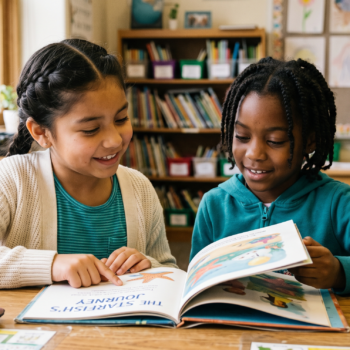
    Two elementary girls smile as they read a picture book together at a classroom desk, sharing the pages of a colorful illustrated story in a warm, book-filled classroom.

    Reading fluency strategies are research-supported instructional practices that build automaticity, the ability to recognize words quickly and effortlessly so that working memory is freed up for comprehension. Without automaticity, a reader like Amara can be entirely accurate and still miss the meaning, because the effort of producing the words has consumed the cognitive space comprehension needs.


    Read More

  • What Is Reading Fluency? What Every Teacher Needs to Know

    A teacher leans in attentively beside a young girl who reads aloud from a picture book at her desk, with other students working independently in the background of a colorful classroom.

    Reading fluency is the ability to read text accurately, at an appropriate rate, and with expression, so that reading sounds like language and the brain is free to make meaning. It matters because when a student pours all her effort into figuring out the words, she has nothing left for understanding them, which is why an accurate reader like Mia can still miss what a passage says.

    Read More

  • What Is a Morpheme? The Word-Building Block Most Teachers Were Never Taught

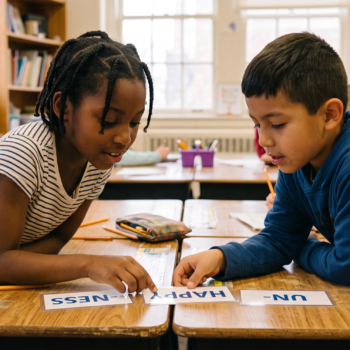
    Two students lean over their desks to arrange morpheme cards showing "un-," "happy," and "-ness" together, building words from their parts during a morphology activity.

    A morpheme is the smallest unit of meaning in a word. Not the smallest unit of sound; that’s a phoneme. Not the smallest pronounceable chunk; that’s a syllable. A morpheme is the smallest piece of a word that carries its own meaning. We spent years teaching students to break words into syllables for decoding. Syllables help students pronounce long words. But morphemes help them understand long words, and that’s a different skill entirely.

    Read More

  • Phonemic Awareness vs Phonological Awareness: Why the Difference Changes What You Teach

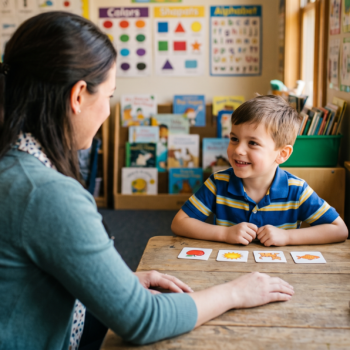
    A teacher sits across from a smiling young boy at a classroom table, working through a phonological awareness activity with picture cards showing an apple, sun, cat, and fish. The boy looks engaged as he listens and responds.

    Phonological awareness is the broad ability to hear and work with the sound structures of spoken language: words, syllables, rhyme, and individual sounds. Phonemic awareness is one skill within that umbrella, hearing and manipulating the individual sounds (phonemes), and it’s the hardest and last to develop. The difference matters because a child can be strong at the easy, early levels and still be missing the phoneme-level skill decoding depends on.

    Read More

  • Phonemic Awareness Assessment: How to Read the Results and Know What to Do Next

    A teacher sits beside a young elementary student at a classroom desk, smiling warmly as the child speaks. The teacher holds a clipboard and pen, suggesting an informal phonemic awareness assessment in progress. Other students work independently in the background.

    A phonemic awareness assessment is a short oral screening that measures whether a child can hear, isolate, blend, segment, and manipulate individual sounds in spoken words, with no print and no pictures involved, and it matters because that sound-level skill is the foundation decoding is built on. A low score doesn’t just flag a struggling reader. It points to a specific, teachable gap underneath the reading.

    Read More