Science of Reading

  • Deleting and Substituting Sounds: Simple Strategies for Teaching Sound Manipulation

    deleting and substituting

    You know those moments when you’re teaching phonemic awareness and you think, “There has to be a way to make this click for my kids”? I had one of those moments last week working with a struggling reader named Maya. We were practicing deleting and substituting sounds, and she just wasn’t getting it. Then I tried something that changed everything – but let me back up a bit first.


    Read More

  • Teaching Blending and Segmenting: Your Guide to These Essential Reading Skills

    teaching blending and segmenting

    You’re sitting with a small group of students, and you can see the wheels turning as they work to sound out a new word. We’ve all been there – watching our students stretch and blend sounds, sometimes smoothly, sometimes with a bit more struggle. Today, let’s dive deep into two absolutely crucial skills that make all the difference in early reading success: blending and segmenting.

    Read More

  • How to Use Choral Reading to Build Fluency in Your Classroom

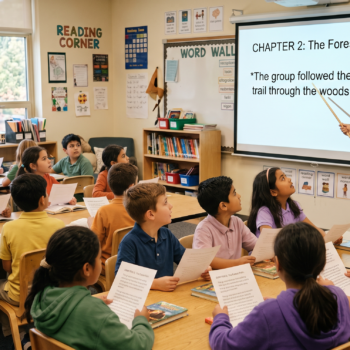
    A teacher points to a projected passage on a screen as a whole class of elementary students follow along on their own printed copies during a choral reading lesson, with a word wall and reading corner visible in the background.

    Choral reading is the entire class reading aloud in unison with the teacher. Every student participates. Every student hears a fluent model. No one reads alone, and no one reads under a spotlight. Think of it like a symphony orchestra’s first rehearsal of a new piece. The experienced players carry the tempo and the phrasing; the less confident ones follow the ensemble rather than stumbling through solo. Over time, the parts that needed the group’s support start to come naturally.

    Read More

  • How to Use Partner Reading to Build Reading Fluency (And Why Structure Is the Difference)

    A girl reads aloud from a copy of Wonders of the Forest while her partner follows along in his own copy at a shared classroom desk during a partner reading activity.

    Structured partner reading works because it delivers two things that build fluency at the same time: repeated oral reading practice and immediate, specific feedback from a peer model. Researchers Doug and Lynn Fuchs at Vanderbilt University studied what happened when teachers paired students intentionally, assigned the text, and gave both partners defined roles for reading, listening, and responding. They found this structured approach produced greater reading gains than comparison classrooms, for struggling readers, average readers, and strong readers alike

    Read More

  • A Teacher’s Guide to Improve Reading Fluency with Decodable Texts

    Improve Reading Fluency

    Can we have a heart-to-heart about decodable texts? I know that moment when you’re sitting with your small group, decodable readers in hand, and you’re thinking, “Shouldn’t we be moving on to ‘real’ books by now?” Trust me, I’ve been there too. After twenty years of working with teachers to improve reading fluency, I’ve learned that these seemingly simple books are actually literacy gold for our beginning readers.

    Read More

  • Making the Most of Decodable Texts In Your Classroom

    decodable text

    Let’s talk about decodable texts – those carefully crafted books that help our young readers practice their phonics skills. In my years as a literacy coach, I’ve seen how helpful these resources can be when used effectively. I know the questions that come up again and again in my coaching sessions: When should we use decodable text? How do we know when students are ready to move beyond them? And most importantly, how do we make sure we’re using them effectively?

    Read More

  • Decodable Texts Decoded: Real Talk About Building Confident Readers

    decodable texts

    You know that feeling when you find something that actually works for your struggling readers? That’s what we’re talking about today. After two decades of supporting teachers and students with reading challenges, I’ve learned that decodable texts are often the missing piece of the puzzle. Grab your favorite pen – you’re going to want to take notes on this one!

    Read More

  • Let’s Talk About Leveled Books (And Why It Might Be Time for a Change)

    leveled books

    Teachers are asking whether they should move away from leveled books. And I totally get it! I remember when my own classroom library was organized with those familiar A-Z labels, and every student had their “just right” reading level. It felt so organized, so systematic. But here’s the thing – I’ve learned some pretty eye-opening stuff about leveled books that changed my whole approach to teaching reading, and I think you’ll find it interesting too.

    Read More