So What Is a Morpheme, Exactly?
A morpheme is the smallest unit of meaning in a word. Not the smallest unit of sound; that’s a phoneme. Not the smallest pronounceable chunk; that’s a syllable. A morpheme is the smallest piece of a word that carries its own meaning.
Take the word cats. One syllable, but two morphemes: cat (the animal) and -s (more than one). The -s changes the meaning of the word. That work is what makes it a morpheme.
Now take purple. Two syllables (pur and ple), but only one morpheme. Neither pur nor ple means anything on its own. The word carries meaning only as a whole unit.
This is the distinction most of us missed in our training. We spent years teaching students to break words into syllables for decoding. Syllables help students pronounce long words. But morphemes help them understand long words, and that’s a different skill entirely.
Most of my early training as a reading interventionist was built around phonics: the relationship between sounds and symbols. Phonics takes care of about 80% of reading, and when words don’t follow the expected patterns, we tend to call them exceptions. I’ve heard teachers explain it as “English is just crazy.” It wasn’t until I took a summer course on Structured Word Inquiry that I started to appreciate how complex and well-structured English actually is. Orthography (how we spell words) and morphology (meaningful word parts) play a big role in how words are built, and teaching those patterns explicitly, just like we teach phonics patterns, supports both reading and vocabulary, especially with multisyllabic words.
The Two Types You Need to Know
Morphemes come in two categories, and the difference matters the moment you start looking at longer words with students.
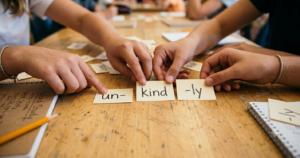
Free morphemes can stand alone as words. Sun, play, kind, book, like, run. Each one carries meaning by itself. That independence is what makes them free.
Free morphemes are the base words that other word parts attach to. In unlikeable, the free morpheme is like. In replayable, it’s play. Strip away every prefix and suffix, and the free morpheme is what remains.
Free morphemes also combine with each other to form compound words. Sunshine is two free morphemes: sun and shine. Doghouse is dog plus house. In a compound word, both parts can stand alone, and that’s what makes this the most natural starting point for morphology work in first and second grade. Students already know these words. They just haven’t been shown yet that the words are made of parts.
Bound morphemes can’t stand alone. They have to attach to another morpheme to do their job. Prefixes like un-, re-, and pre- are bound. So are suffixes like -ing, -ness, and -able. You’d never use un by itself in a sentence; it only works when it’s attached to a word it’s modifying.
Within the category of bound morphemes, there are two smaller groups worth knowing. Inflectional bound morphemes change a word’s grammar without changing its core meaning. When a student adds -ed to jump, the word still means jump; it just happened in the past. Derivational bound morphemes change the actual meaning or the part of speech. Un- reverses meaning (happy becomes unhappy), and -ness turns an adjective into a noun (kind becomes kindness). You don’t need to teach these labels to your students. You just need to know they exist, because the derivational ones are doing most of the heavy lifting in academic vocabulary.
The word unbreakable shows both types working together. Un- is a bound morpheme that means “not.” Break is the free morpheme in the middle. -Able is a bound morpheme that means “can be.” Three morphemes, one word, each doing its own job. And because un- means “not” every time, re- means “again” every time, and -able means “can be done” every time, a student who learns the pattern has a strategy for words nobody has explicitly taught them yet.
Why Morphemes Matter for Reading
Here’s the research finding that stopped me: linguists William Nagy and Richard Anderson (1984) estimated that roughly 60% of the unfamiliar words students encounter in school texts have meanings that can be predicted from their morphemes. Researchers Terezinha Nunes and Peter Bryant (2006) later built on that finding to develop and test classroom programs that teach morphemic awareness directly, with measurable gains in both reading and spelling. That means more than half of the “hard” words your students stumble over in science, social studies, and literature are within reach, as long as students know how to look for the meaningful parts inside them.
This is where morpheme knowledge does something neither phonics nor vocabulary instruction does alone. Phonics helps students pronounce words. Vocabulary instruction teaches specific definitions. Morpheme knowledge does both at once. It helps students figure out how to read a long word and what that word means, in the same moment.
Think about what happened with that fourth grader and unlikeable. He didn’t just decode the word. He constructed its meaning from its parts. That’s a transferable strategy, not memorization.
To understand how morpheme knowledge fits into the bigger picture of how morphology works in reading instruction, that’s the next layer. Morphemes are the building blocks, and morphology is the full system.