Show Students What Fluent Reading Sounds Like: A Guide to Modeled Reading

There’s a kind of struggling reader who has never actually heard what fluent reading sounds like coming out of her own mouth. She can decode. She works through the words. But every sentence comes out flat and effortful, one word at a time, and she has no internal sense of what she’s reaching for, because reading has only ever felt like labor to her.

Modeled reading is how you give her that sense. As a reading interventionist working with beginning readers in first grade, I leaned on it constantly, and the best part is that you are almost certainly already doing a version of it. This post walks through what modeled reading is, how to make the model visible, and how to start this week.

What Is Modeled Reading?

Modeled reading is reading a text aloud fluently while students follow along in the print, watching and listening to what skilled reading sounds like before they produce it themselves. It matters because a student can’t aim for fluent reading until she has heard what it sounds like.

That last part is what sets modeled reading apart from its cousins. In echo reading, students read a line back to you right away. In choral reading, the whole class reads in unison. In partner reading, two students take turns. Modeled reading is the one where students aren’t producing yet at all. They’re watching, they’re listening, and they’re taking in the rhythm and phrasing of a fluent reader before any of it is asked of them. That receiving stage is the whole point, and it’s doing more work than it looks like.

What This Looks Like in a Real Classroom

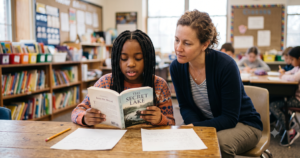
Picture a first grader who reads accurately but in a careful, word-by-word monotone. You sit beside her with a short passage she can decode. You read the first sentence aloud, smoothly, your finger moving under the words as you go. She watches your finger. She hears where you pause, where you group words together, where your voice rises at a question.

Then you stop and notice something out loud. “Did you hear how I read ‘the big brown dog’ all together, like it was one idea? That’s because it is one idea.” You’re not quizzing her. You’re pointing at the thing she just heard so she knows to listen for it.

A few sessions in, something shifts. You hand her a new sentence, and before she reads it, she pauses the way you’ve been pausing. Her phrasing isn’t perfect, but it’s there, borrowed from a model she’s heard enough times to start carrying on her own.

Here’s the encouraging part: if you read aloud to your students, you already do this every day. Modeled reading takes the read-aloud you’re already doing and makes the model deliberate. You don’t have to add a block to your schedule. You have to read the way you already do, and point at what you’re doing while you do it.

Making Modeled Reading Work in Your Classroom

A few practices turn an ordinary read-aloud into a model students can actually use.

Choose a text that lets the model lead. Pick something at or slightly above your students’ independent level. The point isn’t for them to decode it. The point is for them to hear it read well, so a text a notch beyond what they could manage alone is exactly right.

Make the print visible to everyone. Every student needs to see the words as you read them, because the model is visual as much as it is auditory. A document camera zoomed in works. So do individual copies, or a passage on the board. One small move that helps: a reading guide or a strip of highlighter tape under the line you’re reading keeps wandering eyes anchored to the right spot.

Track the words as you read. Point to each word, or sweep your finger under the line, so students can see how you’re grouping words into phrases, not just hear it. This is the move that makes phrasing visible instead of invisible. Teach them to track along with their own finger or a pencil, too.

Read with real expression. Let your voice do what the text means. Lift it for a question, slow it for something sad, lean on the words that carry the weight of the sentence. You’re showing students that expression isn’t decoration. It’s how a reader shows she understands what she’s reading.

Build in stop-and-notice moments. Every so often, pause and name what you just did. “Notice how I slowed down there.” “Did you hear how I made that sound like a question?” These small interruptions turn passive listening into active attention, and they’re what move a model from background noise to something students learn from.

This works because of what students internalize from a fluent model before they ever produce one. Hearing skilled reading is how students build their sense of prosody, the phrasing and expression that make reading sound like language, and it supports the automatic, effortless word recognition that frees the brain to think about meaning.

David and Meredith Liben describe this in Know Better, Do Better: students make real fluency gains when they follow along while listening to a skilled reader. The National Reading Panel reached the same conclusion about guided oral reading with modeling and support (full report). If you want the full picture of how automaticity and prosody actually develop and why they matter this much, reading fluency strategies like this one covers the research behind it.

Twenty years of working with beginning readers taught me to use the model as a decision, not a script. When I had a first grader who was really struggling with fluency, I’d have her read a sentence once just to sound it out, then a second time to make it smooth.

If she got there on her own the second time, I left it alone. But if it was still choppy, or if I wanted her to hear a particular phrasing, I’d read the sentence back to her myself, pointing to each word so she could see how I grouped them. That third pass wasn’t another turn for her. It was so she could hear what she was aiming for, get a little closer to the target each time, and finally have enough attention left over to think about what the sentence actually meant.

What You’ll Notice When It’s Working

The first signal is a student’s phrasing starting to sound like yours. You’ll hand her something new and hear her pause where you’ve been pausing, group words the way you’ve been grouping them. She’s not copying on purpose. She’s reproducing a pattern she’s absorbed from hearing it modeled.

The second signal is attention. A student who used to drift during reading starts watching your finger, tracking the line, leaning into the stop-and-notice moments instead of waiting them out. Listening becomes active. That’s the receiving stage doing its work.

The third signal shows up in comprehension, and it’s the one that surprised me most often. When a student no longer has to white-knuckle every word because she’s heard it modeled and read it smoothly, she suddenly has something left over to think with. She’ll finish a sentence and actually tell you what it meant, instead of arriving at the end emptied out. The model didn’t just smooth her reading. It freed up the room in her head that meaning needs.

Start Here This Week

Pick one short text and one moment in your day you’re already reading aloud. Tomorrow, when you read it, slow down and point to the words as you go. Pause once to notice something out loud about how you read it.

You don’t need a new program, a different set of materials, or any planning time beyond choosing the passage. And the first time you try it, you’re not performing for anyone. You’re finding out what your students do when they get a clear model to follow, and where to take it from there. Watch who starts to track along, who borrows your phrasing first, and who needs to hear it more than once. What you notice will tell you what to do next.

Key Takeaways

  • Modeled reading is reading aloud fluently while students follow along in the print, watching and listening to skilled reading before they’re asked to produce it themselves.
  • It’s distinct from echo, choral, and partner reading because students are receiving the model, not yet performing, and that receiving stage is what builds their sense of what fluent reading sounds like.
  • You’re already doing a version of it every time you read aloud. Making the model deliberate means tracking the words as you read and pausing to notice what you did.
  • The clearest sign it’s working isn’t smoother reading alone. It’s a student with enough attention freed up to finally think about what the sentence meant.


All student and classroom examples in this post are composites drawn from the author’s professional experience. Names and identifying details have been changed. No example represents a single identifiable student.

Hello!

My Mission is Simple

Give teachers the science-backed tools they need to help every student become a confident reader.
I’m so glad you’re here! 

Where to Go From Here

Give me the Quiz!

Modeled reading is one piece of building fluent readers, and a flat, word-by-word reader is one of the signs that’s easiest to miss when a student’s accuracy looks fine on paper. I put together a free guide called 5 Silent Signs Your Students Are Struggling to Read to help you spot the others. Grab it and see which signs you recognize in your own classroom.

Where This Research Comes From

Recommended Reading

  • Know Better, Do Better: Teaching the Foundations of Reading — David & Meredith Liben — A practitioner guide to foundational reading instruction that lays out why modeling plus practice is what builds fluency.
  • The Megabook of Fluency — Timothy V. Rasinski & Melissa Cheesman Smith — A classroom resource for fluency instruction across grade levels, with direct guidance on modeling and repeated reading routines.

Research Sources

As an Amazon Associate, I earn on qualifying purchases.

Two elementary girls smile as they read a picture book together at a classroom desk, sharing the pages of a colorful illustrated story in a warm, book-filled classroom.
Science of Reading

Reading Fluency Strategies That Actually Build Automaticity

Reading fluency strategies are research-supported instructional practices that build automaticity, the ability to recognize words quickly and effortlessly so that working memory is freed up for comprehension. Without automaticity, a reader like Amara can be entirely accurate and still miss the meaning, because the effort of producing the words has consumed the cognitive space comprehension needs.

Read More »
A teacher leans in attentively beside a young girl who reads aloud from a picture book at her desk, with other students working independently in the background of a colorful classroom.
Science of Reading

What Is Reading Fluency? What Every Teacher Needs to Know

Reading fluency is the ability to read text accurately, at an appropriate rate, and with expression, so that reading sounds like language and the brain is free to make meaning. It matters because when a student pours all her effort into figuring out the words, she has nothing left for understanding them, which is why an accurate reader like Mia can still miss what a passage says.

Read More »
fluency and comprehension
Science of Reading

Fluency and Comprehension: Teaching Students to Read in Meaningful Phrases (And Why It Matters)

Have you ever watched a struggling reader laboriously sound out each word, only to reach the end of the paragraph with little understanding of what they just read? This common classroom scenario illustrates the critical relationship between fluency and comprehension—a connection that’s often misunderstood or under appreciated in our reading instruction.

Read More »

Grab your free lesson plan!

You're Just a Click Away!