What Partner Reading Actually Looks Like When It’s Working
Neel was a first grader who knew his letter sounds and could blend. The problem wasn’t his phonics. Every word cost him the same effort, every time he encountered it. The word the on page twelve took the same deliberate decoding as the on page one. By the time he worked his way to the end of a sentence, the beginning had evaporated from his working memory.
What Neel needed was what unstructured partner reading can’t give: a fluent model sitting right next to him, reading the same text first, and a partner who would catch his errors before they became habits.
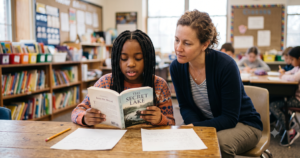
In a classroom where partner reading has real structure, that’s exactly what happens. The stronger reader goes first, not because she reads more but because her reading gives her partner a model of what the text sounds like at an appropriate pace, with appropriate expression. Then the developing reader reads the same section. His partner follows along in her own copy of the text, marking errors, ready to respond with something specific: what went well, and one thing to work on next time.
You’re already running reading time. Partner reading structured this way takes what you’re already doing and makes it do more.
The Framework in Steps
Structured partner reading works because it delivers two things that build fluency at the same time: repeated oral reading practice and immediate, specific feedback from a peer model. Researchers Doug and Lynn Fuchs at Vanderbilt University studied what happened when teachers paired students intentionally, assigned the text, and gave both partners defined roles for reading, listening, and responding. They found this structured approach produced greater reading gains than comparison classrooms, for struggling readers, average readers, and strong readers alike (Fuchs, Fuchs, Mathes, & Simmons, 1997).
That word structured is doing all the work. Here’s what it means in practice:
I’ve been in classrooms where partner reading is on the schedule every day and students are going through the motions — one reads, one waits, they switch. And I’ve been in classrooms where it’s genuinely building fluency. The difference I keep coming back to is the listener. In the first kind of classroom, the listening partner has nothing to do. In the second, she has her own copy of the text, she’s marking errors, and when it’s her turn to give feedback, she knows exactly how to do it. That’s not something students figure out on their own. It’s taught.
Step 1 — Pair with intention, not convenience. Match a stronger reader with a developing reader, but keep the gap manageable. If the gap is too wide, the stronger reader is bored and the developing reader is exposed. Students far below grade level need adult support, not a peer partner. The pairing isn’t just about fluency data, either. A highly expressive reader paired with a student working on prosody often does more than data alone would predict.
Step 2 — Assign the text. The passage should sit at the developing reader’s instructional level: challenging enough to require practice, not so hard that error correction becomes the entire activity.
Step 3 — The stronger reader goes first. One section at a time. The developing reader follows along in her own copy. She’s not waiting for her turn. She’s listening and tracking.
Step 4 — Teach the listener’s job explicitly. This is the step most implementations skip. The listening partner marks errors on her own copy of the text. When it’s time to give feedback, she leads with something specific that went well, then names one thing her partner can work on next time. Not a list of every error. One thing. Students need this modeled repeatedly before they’ll do it independently. Sentence stems help: “I noticed you read that smoothly” and “One thing to try next time is…”
Step 5 — Switch. The developing reader reads the same section back. The stronger reader now takes the listener role.
This sequence works because of how fluency develops at the brain level: decoding has to become automatic enough to free up working memory for meaning. If you want the full picture of how automaticity connects to comprehension, reading fluency strategies like this one covers the research behind it.
What You’ll Notice When It’s Working
The first signal is what the listening partner does with an error.
In classrooms where partner reading hasn’t been structured, the listening partner either doesn’t notice the error or doesn’t know what to do with it. She waits. He keeps reading. The error goes uncorrected, and the session ends having produced more reading time, not better reading.
In classrooms where the routine has been explicitly taught, the listening partner catches the error, points to the word, and responds with something specific. That feedback loop is what makes the session function as instruction rather than practice: the error is named, the word is corrected, the sentence is reread. It’s the detail that separates the two kinds of classrooms.
The second signal is pace. When the stronger reader has modeled first and both partners know their roles, the developing reader’s reading in round two often sounds different from independent reading at the same level. The model primes the prosody. Students who read word-by-word in isolation will sometimes hold a phrase together in a partner reading session because they just heard it done.
The third signal shows up over time. The developing reader starts self-correcting before her partner has a chance to respond. That’s automaticity beginning to transfer, and it’s exactly what structured partner reading is designed to produce.