• Phonological Awareness vs Phonics: Why One Comes First

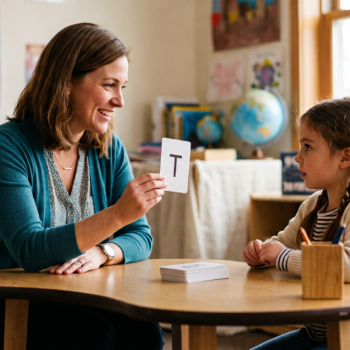
    A teacher leans in to talk with a young student at a small table in a cozy reading corner

    Phonological awareness is the ability to hear and work with the sounds in spoken language, syllables, rhymes, and individual phonemes, with no print involved. Phonics connects those sounds to letters. The difference matters because phonological awareness has to develop first: a student can’t map sounds to letters she can’t yet hear in the first place.

    Read More

  • Onset-Rime Awareness: The Bridge Between Syllables and Sounds

    A teacher sits in a low chair facing two students on a classroom rug, smiling warmly as the children listen attentively during a small group onset-rime awareness lesson.

    Onset-rime awareness is the ability to hear a single syllable split into two parts: the onset, which is the consonant or consonants before the vowel, and the rime, which is the vowel and everything after it. In “map,” /m/ is the onset and /ap/ is the rime. It matters because it’s the first time a child works inside a syllable instead of with whole chunks, and that shift is what makes the smaller, harder phoneme work possible later.

    Read More

  • Syllable Awareness: Why It’s Where Phonological Awareness Begins

    A teacher leans in closely as a young boy uses colored tiles to tap out syllables in the word "butterfly," with a picture card of a monarch butterfly on the table in front of him.

    Syllable awareness is the ability to hear, count, blend, and break apart the syllables in a spoken word, the “beats” you’d tap out in but-ter-fly or pen-cil. It matters because the syllable is the first and easiest level of phonological awareness a child can hear, which makes it the natural starting point for teaching and screening the sound skills reading depends on.

    Read More

  • Phonological Awareness Activities: What to Practice at Each Level of the Sound Continuum

    A teacher cups her hands around her mouth and whispers a sound to a delighted group of students sitting on a classroom rug, with a girl across from her laughing in anticipation during a playful phonological awareness activity.

    Phonological awareness develops from big units of sound down to small ones, and the activities follow that same path. Run them in this order. Every one is oral, needs no materials, and fits in five to ten minutes. This sequence works because phonemic awareness sits at the top of the phonological awareness continuum, and the levels underneath have to hold before the top one can.

    Read More

  • Phonics Scope and Sequence: Why the Order You Teach In Matters

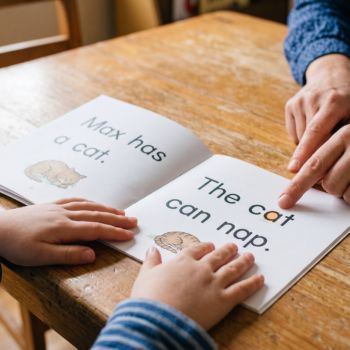
    A teacher points to words in a decodable reader showing the sentences "Max has a cat" and "The cat can nap" while a young child follows along with both hands on the page.

    A phonics scope and sequence is the planned order in which letter-sound patterns are taught, moving from simple to complex, with each new skill building on the ones before it. It matters because reading is cumulative: a student who misses a rung in the progression stalls at exactly that point, no matter how solid the rungs below it are.

    Read More

  • Phonics Rules: Which Patterns Are Actually Reliable (and Which Aren’t)

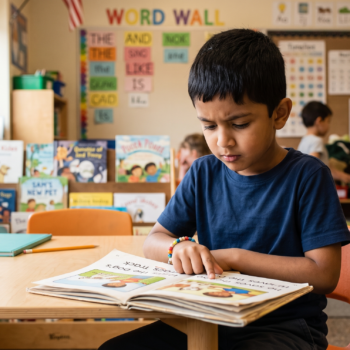
    A young boy tracks text with his finger as he reads a decodable reader at his classroom desk, with a colorful word wall and well-stocked book shelves visible behind him.

    Phonics rules are the reliable patterns that connect letters and letter combinations to the sounds they represent: digraphs, vowel teams, silent-e, r-controlled vowels, and the syllable types that organize them. They matter because these patterns are what let a reader decode a word she has never seen before, instead of sounding it out letter by letter and landing on a non-word the way Henry did with rain.

    Read More

  • Synthetic Phonics: What It Actually Is and Why It Matters for Your Students

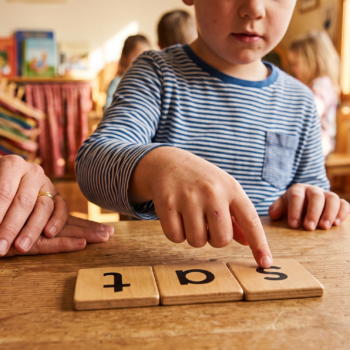
    A young child points to wooden letter tiles spelling "sat" on a table during a synthetic phonics lesson, with a teacher seated alongside providing support.

    Synthetic phonics is a method of teaching reading that starts with individual sounds and the letters that represent them, taught one at a time in a planned order, and then has students blend those sounds together to read whole words. It matters because this part-to-whole sequence is the approach most consistently supported by reading research for beginning and struggling readers. It doesn’t assume students already hear the sounds inside words. It builds that skill first.

    Read More