Synthetic Phonics: What It Actually Is and Why It Matters for Your Students

Picture two first graders meeting the word sat for the first time.

The first one was taught the sounds before she ever saw the word. She knows /s/, she knows /a/, she knows /t/. So she does what she’s been shown: she says each sound and pushes them together. /sss/ /aaa/ /t/. Sat. She built the word out of parts she already had.

The second one was handed the whole word and asked to study it: sat starts like sun, rhymes with cat, here’s what it says. She’s noticing patterns in a word someone gave her, rather than building one of her own.

Both children are doing phonics. But they’re moving in opposite directions, and for a reader who is still figuring out how print works at all, the direction turns out to matter enormously. The first child is doing synthetic phonics. This post is about why, for beginning and struggling readers, that direction is the one the research keeps pointing to.

After years as a reading interventionist and literacy specialist working with struggling readers in grades K–5, I’ve been trained in two very different approaches to phonics: Orton-Gillingham first, then Structured Word Inquiry a few summers later. They come at the code from opposite directions. But for a beginning reader who hasn’t yet built the letter-sound connection at all, the research points clearly in one direction.

So What Is Synthetic Phonics, Exactly?

Synthetic phonics is a method of teaching reading that starts with individual sounds and the letters that represent them, taught one at a time in a planned order, and then has students blend those sounds together to read whole words. It matters because this part-to-whole sequence is the approach most consistently supported by reading research for beginning and struggling readers. It doesn’t assume students already hear the sounds inside words. It builds that skill first.

That’s the “synthetic” part. Not synthetic like artificial. Synthetic like synthesize: putting parts together to make a whole.

A student learning this way would learn the sounds /s/, /a/, and /t/ individually. Then she’d practice blending them: /sss/, /aaa/, /t/. Sat. She’s built the word from its parts. She hasn’t memorized it. She hasn’t guessed it from a picture. She’s decoded it.

How Analytic Phonics Is Different

Analytic phonics moves in the opposite direction. It starts with whole words students already recognize and has them analyze the patterns inside. You read the book together. You notice that bat and cat rhyme, or that ship starts with /sh/. Students discover the patterns through exposure rather than learning them in a planned sequence first.

Analytic phonics is not the same as no phonics. For students who already have the alphabetic code, analytic work can do real teaching, especially around spelling patterns and word meaning. I’ll come back to that. But for a student still building the sound-letter connection itself, the direction matters.

Why the Direction Matters for Reading

When phonics instruction starts with whole words, it assumes students can already hear the individual sounds inside those words. For some kids, that assumption holds. For the ones who can’t yet, it doesn’t.

Synthetic phonics doesn’t make that assumption. It teaches the connection between each sound and its letter explicitly, before asking students to read words that contain it. The scope and sequence is planned before the school year starts, not discovered along the way.

The convergence of research on this is substantial. Linnea Ehri’s meta-analysis of the National Reading Panel’s phonics data and the Rose Review in England both point to the same conclusion: explicit, systematic, part-to-whole phonics instruction is the most effective approach for teaching children to decode, and for reaching the students who struggle most.

If you want to see how this fits into the full picture of what phonics is and how it works, that’s worth reading too.

I remember the summer I sat down with a stack of leveled readers and a spreadsheet, transcribing every word in the green level, certain I’d find a phonics sequence hiding underneath. There wasn’t one. Leveled texts are organized by sentence complexity and vocabulary load, not sound-spelling patterns. That realization changed everything about how I understood what my students needed.

What Synthetic Phonics Looks Like in a Real Classroom

Walk into a classroom teaching this way and the instruction is specific enough that you can name what you’re seeing in the first few minutes.

You’d see a scope and sequence. A plan that moves from common consonant sounds and short vowels through digraphs, long vowel patterns, and eventually multisyllabic words. Students have been taught each pattern before they’re asked to read it.

You’d see a daily phonics block, usually 15 to 20 minutes, where the teacher introduces a new sound-spelling correspondence, models blending, and gives immediate practice. Students might use letter tiles, sound boxes, or whiteboards to map sounds onto letters.

And you’d see decodable texts. Short books made up of patterns students have already been taught. When a first grader sits down with one, she can actually read every word on the page. Not because she’s memorized the book, but because she knows every sound-spelling pattern in it.

What you’d also still see: the classroom library. Read-alouds. Conversations about books. This is a 15-to-20-minute block, not a philosophy that replaces everything else. It gives your students the code. The rest of your instruction gives them the reason to use it.

Where Analytic Work Earns Its Place

Once students have the sound-letter code, there’s real work that analytic approaches do better. I learned this the summer I did an intensive workshop in Structured Word Inquiry, which uses word study to teach the parts of English that sound-symbol work can’t fully explain: orthography (how we spell) and morphology (how meaning units build and change words). English is not strictly phonological. Students need both halves.

When I’m teaching the long-a sound now, I group the spellings that make it. Ai and ay both make the same sound, so I put example words in front of students and we do a guided word sort: rain, play, train, day, pail, stay. Students discover, on their own, that ai tends to sit at the beginning or middle of a syllable while ay sits at the end. That’s analytic work. It is what comes after the synthetic instruction that got them able to decode those words.

Synthetic phonics builds the code. Analytic work, done well, is how students use the code to read and spell with precision.

The Misconception That Keeps Teachers Stuck

The most common thing I hear when this comes up is some version of: “Phonics is phonics — does the direction really matter?”

It’s a fair question. If a child ends up knowing her sound-spelling patterns either way, why fuss over whether she built words up from sounds or picked patterns out of whole words? Here’s why: the direction decides what happens when a child meets a word she has never seen. A reader taught to synthesize has a move that works on any word — say the sounds, blend them, check it.

A reader who learned by analyzing familiar words has a strategy that depends on already knowing words that look similar. For the confident reader, both get you there. For the beginner, and for the struggling reader especially, only one of them is a strategy she can use when she’s alone with an unfamiliar word and no one to ask.

That’s the whole case for starting with synthetic. Not that analytic work is wrong, but that part-to-whole gives a new reader something to do the moment the training wheels come off.

What This Means for Your Teaching

Here’s one thing you can do this week: pull up the phonics component of your core reading program. Look at whether the sounds and patterns are taught in a specific, planned order, or whether they show up as they arise in the texts you’re reading together. That one observation will tell you a lot about whether your students are getting explicit, systematic instruction or something else.

And if the answer is something else, that’s not an ending. It’s a starting point.

Key Takeaways

  • Synthetic phonics teaches individual sounds and their letters first, then blends them into words in a planned, part-to-whole sequence.
  • Analytic phonics moves in the opposite direction, starting with whole words and analyzing the patterns inside, and is most useful for spelling and word study once the alphabetic code is in place.
  • The research consistently supports explicit, systematic, part-to-whole phonics instruction as the most effective approach for beginning and struggling readers.
  • Both approaches can earn a place in your instruction. What matters is matching the approach to what your students need next.


The classroom examples in this post are composites drawn from the author’s professional experience across grades K–5. Names and identifying details have been changed, and no example represents a single identifiable student.

Hello!

My Mission is Simple

Give teachers the science-backed tools they need to help every student become a confident reader.
I’m so glad you’re here! 

Where to Go From Here

Give me the Quiz!

If you’re starting to look at your students differently, wondering which ones are actually decoding and which ones have gotten very good at looking like they are, you’re not alone. I put together a free guide called 5 Silent Signs Your Students Are Struggling to Read that walks through the patterns most teachers miss. It’s the starting place I wish I’d had.

Where This Research Comes From

Research Sources

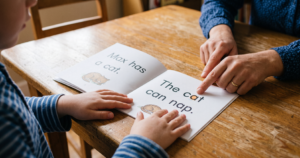
A teacher points to words in a decodable reader showing the sentences "Max has a cat" and "The cat can nap" while a young child follows along with both hands on the page.
Science of Reading

Phonics Scope and Sequence: Why the Order You Teach In Matters

A phonics scope and sequence is the planned order in which letter-sound patterns are taught, moving from simple to complex, with each new skill building on the ones before it. It matters because reading is cumulative: a student who misses a rung in the progression stalls at exactly that point, no matter how solid the rungs below it are.

Read More »
A young boy tracks text with his finger as he reads a decodable reader at his classroom desk, with a colorful word wall and well-stocked book shelves visible behind him.
Science of Reading

Phonics Rules: Which Patterns Are Actually Reliable (and Which Aren’t)

Phonics rules are the reliable patterns that connect letters and letter combinations to the sounds they represent: digraphs, vowel teams, silent-e, r-controlled vowels, and the syllable types that organize them. They matter because these patterns are what let a reader decode a word she has never seen before, instead of sounding it out letter by letter and landing on a non-word the way Henry did with rain.

Read More »
A smiling teacher holds up a letter card showing the letter T as a young girl looks on attentively during a one-on-one systematic phonics lesson at a small classroom table.
Science of Reading

Systematic Phonics Instruction: What Makes Phonics a System, Not a Worksheet

Systematic phonics instruction means teaching letter-sound relationships in a planned sequence, where each new skill builds on the ones before it and earlier skills stay in review. It matters because most children don’t absorb the code from exposure; the gaps that open up when phonics is taught in scattered pieces are the same gaps that turn into struggling readers.

Read More »

Grab your free lesson plan!

You're Just a Click Away!