Phonics Rules: Which Patterns Are Actually Reliable (and Which Aren’t)

Neel can read map, sat, and fan without blinking. He blends the sounds, says the word, moves on. His letter sounds are solid, and he can segment a spoken word into its parts and put it back together. On a phonics screening, he looks fine.

Then he gets to rain.

He starts the way he always does, sound by sound: /r/ … /a/ … and then he treats the i as its own sound, and the n, and produces something that isn’t a word. He frowns. He tries again, same way, same result. Nobody has shown Neel that ai is one team that says one sound. So he’s doing exactly what he was taught, sounding out every letter, on a word where that strategy quietly stops working.

Neel isn’t missing effort or motivation. He’s missing the patterns. After years as a reading interventionist working with struggling readers in grades K–5, I can tell you that the wall Neel hit has a name, and it’s the subject of this whole post: phonics rules. Not whether phonics works, but what the patterns actually are once a reader moves past simple three-letter words, and how dependable those patterns really are.

What “Phonics Rules” Actually Means

Phonics rules are the reliable patterns that connect letters and letter combinations to the sounds they represent: digraphs, vowel teams, silent-e, r-controlled vowels, and the syllable types that organize them. They matter because these patterns are what let a reader decode a word she has never seen before, instead of sounding it out letter by letter and landing on a non-word the way Henry did with rain.

It helps to be precise about what we mean by a “rule,” because the word carries baggage. Some are single correspondences: sh says /sh/, ck says /k/. Some hold across a whole category of words: when a vowel is followed by r, the r changes the vowel’s sound, so car, her, and bird don’t behave like cat, hen, and bid. And some are broad generalizations meant to predict pronunciation, like the old rhyme “when two vowels go walking, the first one does the talking.”

That last category is where phonics got its shaky reputation, and the reputation is mostly undeserved.

Why the Patterns Matter More Than Their Reputation Suggests

Here’s the research that gets misused constantly. In 1963, Theodore Clymer analyzed 45 common phonics generalizations pulled from the basal teacher’s manuals of his day and tested each against a list of 2,600 words. Using 75% accuracy as his bar for “useful,” he found only 18 of the 45 met it. The “two vowels go walking” rule held up just 45% of the time (Clymer, 1963 ERIC record).

For decades, that finding has been waved around as proof that phonics rules don’t work and teaching them wastes time. I hear the classroom version of it too: a teacher hits a word that breaks the pattern, shrugs, and says “that’s just because English is crazy” — and genuinely believes she’s doing her students a favor by saying so. I understand the instinct, but I’ve come to believe the opposite.

The more a teacher understands these phonics patterns, the more the language makes sense to her, and the better she can help her students make sense of it too. Clymer wasn’t proving English is chaos. He was testing a set of vaguely stated generalizations, many poorly worded to begin with. When Francine Johnston revisited his study, she showed that several of those same rules become far more reliable once they’re restated precisely or restricted to the words they actually apply to (Johnston, 2001 Full text).

This is where understanding what phonics is and how it fits into learning to read changes how you read that statistic. English looks chaotic when you judge it by a handful of rhyming rules. It looks far more orderly when you account for where a letter sits in a word and what kind of syllable it lives in. A large analysis of English spelling found that letter-to-sound patterns are considerably more predictable once syllable position is taken into account than a raw letter-by-letter count suggests (Hanna, Hanna, Hodges, & Rudorf, 1966 ERIC record). The code isn’t broken. We were just describing it badly.

What the Reliable Patterns Look Like

So which patterns actually earn a place in your teaching? The dependable ones fall into a few groups.

Consonant digraphs are two letters that make one sound: sh, ch, th, wh, ck, ng. These are highly reliable. A child who knows sh says /sh/ will read ship, shop, wish, and brush correctly almost every time.

Vowel teams are the pattern Henry was missing: two vowels working together as one sound. Ai and ay spell long a, ee and ea spell long e, oa spells long o, igh spells long i. Some vowel teams have more than one sound (ea says /ē/ in meat but /ĕ/ in bread), so they’re less airtight than digraphs. But the common ones are dependable enough to teach as patterns, with the variations named honestly.

Silent-e signals that the preceding vowel is long: cap becomes cape, kit becomes kite. R-controlled vowels (ar, er, ir, or, ur) change the vowel sound entirely. And position-based patterns are some of the most reliable of all: ck, tch, and dge appear at the ends of words, never the start, which is why we write catch and back but never ckat.

Underneath all of this sit the six syllable types: closed, open, silent-e, vowel team, r-controlled, and consonant-le. These are the organizing layer, the difference between decoding map and decoding rain, cape, bird, and table. A reader who knows syllable types can break a long word into chunks she can actually read, instead of facing every multisyllabic word as a brand-new puzzle.

What This Means for Your Teaching

Here’s the honest gap. Knowing these patterns exist, that vowel teams and syllable types are a finite, learnable set rather than a pile of random exceptions, is different from knowing how to sequence them, when to introduce each one, and how to spot which pattern a student is missing. That second kind of knowledge is training, and most of us didn’t get it. Our preparation programs treated phonics as a thin chapter, not a body of content to master. That’s a gap in the training, not in you.

But you can start noticing. This week, when a student stalls on a word, look at what kind of word it is. Is it a vowel team? A silent-e word? A multisyllabic word with a syllable break she can’t find? The pattern in the words a student misses will tell you more about what to teach next than any single score.

Key Takeaways

  • Phonics rules are the reliable patterns (digraphs, vowel teams, silent-e, r-controlled vowels, and syllable types) that let a reader decode words she has never seen before.
  • The famous finding that many phonics rules are “unreliable” comes from testing a handful of vaguely worded generalizations; the high-utility patterns are dependable, and the weak rules improve sharply when restated or restricted.
  • English is far more orderly than its reputation suggests once syllable position and word structure are taken into account.
  • Knowing the patterns exist is different from being trained to sequence and teach them, and that gap is a training failure, not a personal one.


All student names and identifying details in this post are fictional composites drawn from real classroom observations across 20+ years of teaching and reading intervention work. No profile represents a single identifiable child.

Hello!

My Mission is Simple

Give teachers the science-backed tools they need to help every student become a confident reader.
I’m so glad you’re here! 

Where to Go From Here

Give me the Quiz!

If Neel reminded you of a reader in your own room — the one who sounds fine on simple words but stalls the moment a word gets more complex — I put together something for you. It’s called 5 Silent Signs Your Students Are Struggling to Read, and it walks through the patterns I see most often in students whose reading difficulties are hiding in plain sight. Get the free guide here.

Where This Research Comes From

Recommended Reading

Research Sources

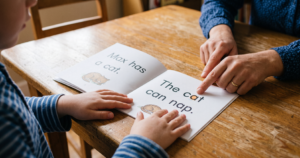
A teacher points to words in a decodable reader showing the sentences "Max has a cat" and "The cat can nap" while a young child follows along with both hands on the page.
Science of Reading

Phonics Scope and Sequence: Why the Order You Teach In Matters

A phonics scope and sequence is the planned order in which letter-sound patterns are taught, moving from simple to complex, with each new skill building on the ones before it. It matters because reading is cumulative: a student who misses a rung in the progression stalls at exactly that point, no matter how solid the rungs below it are.

Read More »
A smiling teacher holds up a letter card showing the letter T as a young girl looks on attentively during a one-on-one systematic phonics lesson at a small classroom table.
Science of Reading

Systematic Phonics Instruction: What Makes Phonics a System, Not a Worksheet

Systematic phonics instruction means teaching letter-sound relationships in a planned sequence, where each new skill builds on the ones before it and earlier skills stay in review. It matters because most children don’t absorb the code from exposure; the gaps that open up when phonics is taught in scattered pieces are the same gaps that turn into struggling readers.

Read More »
A young child points to wooden letter tiles spelling "sat" on a table during a synthetic phonics lesson, with a teacher seated alongside providing support.
Science of Reading

Synthetic Phonics: What It Actually Is and Why It Matters for Your Students

Synthetic phonics is a method of teaching reading that starts with individual sounds and the letters that represent them, taught one at a time in a planned order, and then has students blend those sounds together to read whole words. It matters because this part-to-whole sequence is the approach most consistently supported by reading research for beginning and struggling readers. It doesn’t assume students already hear the sounds inside words. It builds that skill first.

Read More »

Grab your free lesson plan!

You're Just a Click Away!