What “Phonics” Actually Means — and What It Doesn’t
Phonics is the understanding that letters and letter patterns represent specific sounds in spoken language. Phonics instruction means directly and systematically teaching students to connect speech sounds (phonemes) to their written representations (graphemes), and to use those connections to decode and spell words.
Here’s what most of us were never told in our training: the human brain is not wired to read. It is wired to speak. Children learn to talk through exposure. Reading doesn’t work that way. Reading is a cultural invention, and the brain has to build entirely new pathways to do it, pathways that connect speech sounds to printed letters. The cognitive neuroscientist Mark Seidenberg describes reading as a kind of “aftermarket add-on” to a brain built for speech, in Language at the Speed of Sight.
That connection is called the alphabetic principle. And it doesn’t develop on its own, no matter how many books are in your classroom library.
If you were trained the way I was, this wasn’t part of the conversation. I was taught that children learn to read by being immersed in rich, meaningful texts. That was a reasonable thing to believe. But it was incomplete, and for some students, that gap was the difference between learning to read and learning to fake it.
Why Is Phonics Important for Every Reader?
Phonics is important because the brain isn’t wired to read. It must be explicitly taught to connect sounds to letters, and without that instruction, students develop workarounds that mask the gap.
Those workarounds take a few predictable forms. Students memorize. They guess from pictures. They use the first letter and context to predict a plausible word. These strategies can carry a child through predictable books in kindergarten and first grade, and they collapse when text becomes more complex and the pictures disappear.
Mateo was a workaround expert. So are a lot of students sitting in our classrooms right now, looking like readers and falling further behind every year they go without learning the code.
The research on this is not new. Decades of converging evidence confirm that systematic, explicit phonics instruction prevents reading failure for beginning readers and closes gaps for struggling readers of any age. The National Reading Panel’s meta-analysis (Ehri et al., 2001) found systematic phonics outperformed whole-language and embedded approaches, with the largest effects in kindergarten and first grade. And the gap between readers and non-readers doesn’t narrow over time. It widens. Students who read well read more and build more knowledge. Students who can’t decode fall further behind, year after year.
That’s why phonics instruction isn’t optional for the students we’re most worried about. The ones who slip through are rarely the ones who look like they’re struggling. They’re the ones who look fine until the text outgrows their workarounds.
If you want to understand the full picture of what phonics is and how systematic instruction works, that’s the deeper conversation. But the “why” starts here: the students who don’t receive explicit instruction in the code are the students who get left behind.
What This Looks Like in a Real Classroom
You probably already have phonics in your classroom. Most balanced literacy programs include letter-sound work. It comes up during shared reading, or you mention a spelling pattern when a student hits an unfamiliar word. That’s incidental phonics, and it’s not the same thing as systematic phonics instruction.
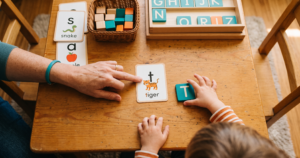
Systematic means there’s a planned sequence, skills introduced from simple to complex, each building on the last. Explicit means the teacher is directly showing students how sounds and letters connect, not waiting for them to discover it. Students practice with texts matched to the patterns they’ve been taught.
When I first understood this distinction, I felt relief and frustration at the same time. Relief because it explained why some of my students weren’t progressing. Frustration because nobody in my training had made it clear. I was doing phonics — or I thought I was. What I wasn’t doing was teaching it in a sequence, connected to decodable texts where students could actually apply what they’d learned.
Remember Mateo? After his teacher introduced systematic phonics instruction with decodable texts, something shifted. He picked up a decodable reader, looked at the first word, and did something I had never seen him do: he tried to sound it out. “Sss… aaa… t. Sat.” He turned to the next word. “M… aaa… t. Mat.” It took him four minutes to read one page. A leveled reader would have taken thirty seconds, thirty seconds of memorized text that bypassed print entirely. Four minutes of actual decoding was slower, harder, and the first time Oliver had read.
That’s a training gap, not a teaching gap. You were taught what you were taught, and you taught it with care.