Explicit Phonics Instruction: What Teacher-Led Modeling Actually Looks Like

I once sat down beside a first grader named Leo with a single decodable book between us. Not the book his class was reading. The one matched to the level his phonics knowledge actually reached that week. He looked at it the way you’d look at something you’d already decided you couldn’t do.

So I didn’t ask him to. I read the first word and pointed to it. I read the second and pointed to that. Then I pointed to the third word and waited. Not the kind of waiting that puts pressure on a kid. Just present. He looked at it. It was sit. He said it under his breath first, like a test he wasn’t sure he was allowed to pass. Then, louder: “Sit.” He read the next word. And the next.

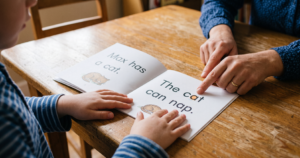
That small sequence, where I read it, then we looked at it together, then he did it on his own, is the whole idea behind explicit phonics instruction. It’s the teacher showing the move first, instead of arranging a print-rich room and hoping the child figures it out by being near it. In years of reading intervention with struggling readers in grades K–5, I came to see that the difference between showing and hoping is most of the difference between the kids who learn to decode and the kids who don’t.

What “Explicit” Actually Means Here

Explicit phonics instruction is a delivery method: the teacher states the sound-spelling connection directly and models how to use it, rather than expecting students to infer it from exposure, context, or repeated guessing. It matters because the alphabetic code is not something the brain discovers on its own, and a child left to figure it out alone is a child quietly being set up to fall behind.

The word explicit is doing real work there. It means nothing essential is left for the student to guess at: the teacher says the sound, shows how the sounds blend, and demonstrates the exact thing she wants the student to do, out loud, where the student can see and hear it. The opposite is implicit instruction, which surrounds a child with books and language and trusts that the rules of print will surface on their own. Some children do seem to pick it up that way. Most do not, and the ones who don’t are rarely the ones raising their hands to say so.

Why the Showing Is the Point

Reading is not natural the way talking is. Children grow into spoken language by being immersed in it, but written language is a code somebody invented, and the brain has no built-in circuit waiting to crack it. Marilyn Adams made this case in Beginning to Read: the path runs from direct instruction in the code, to a working link between the letters and the sounds they stand for, to automatic word recognition, and only then to comprehension. Skip the first step and the rest of the chain never forms.

This is why the modeling can’t be treated as a warm-up you rush through to get to the “real” practice. The modeling is the instruction. When a teacher shows the move first, the student doesn’t spend energy figuring out what the task even is. That energy goes straight to the move itself. The research backs the showing. The National Reading Panel’s meta-analysis, published by Ehri and colleagues, found that systematic, explicit phonics instruction produced stronger reading outcomes than instruction that left the code implicit, with the largest gains in the earliest grades. The federal practice guide on foundational reading lands in the same place, naming explicit letter-sound instruction as a core recommendation.

Most of us were never taught this part. Explicit-instruction technique was a thin chapter, if it appeared at all, in the program that prepared us to teach reading. That’s a gap in the training, not a gap in anyone’s care.

What This Looks Like in the Room

If you watched explicit phonics instruction happening well, you’d see a rhythm with three beats: I do, we do, you do.

I do. The teacher goes first. She holds up the spelling, says the sound (the sound, not the letter name), and models blending a word aloud while the students watch: /m/ /a/ /p/, map. She isn’t quizzing yet. She’s demonstrating.

We do. The teacher and students do it together. She points, they say each sound with her, they blend it as a group. If a sound wobbles, she catches it and models it again. Nobody is on the spot alone.

You do. The student does it independently while the teacher watches. This is the beat Theo reached when I stopped reading and just pointed. The handoff is gradual on purpose. The support comes off one layer at a time, so that by the time a child is reading a word by himself, he has already heard it modeled and practiced it with help.

Explicit phonics instruction is one piece of a larger, planned approach to teaching the code, and how those pieces fit together is covered in systematic phonics instruction. What you would not see in a strong explicit lesson is a child told to look at the picture, skip the hard word, or guess what would make sense. You’d see a teacher showing, then sharing the work, then stepping back.

And here is the thing worth sitting with. When the support came off and Leo had read six words in a row, he went completely still. Not the stillness of a kid concentrating hard. The still of a six-year-old quietly revising what he thought he was capable of. The modeling is what got him there. Not a worksheet, not a sticker, not more time near books. Someone showed him the move, and then let him make it himself.

One Thing People Get Wrong About It

The most common misread is that explicit, teacher-led instruction means rigid, scripted, joyless drill: a teacher reading a script in a flat voice while children fill in blanks. That picture is what makes a lot of teachers want nothing to do with the word explicit.

But explicit is about who supplies the model, not about tone. It says the teacher provides the demonstration instead of leaving the child to guess. It says nothing about being cold, fast, or robotic. The warmest moments I’ve had teaching reading were explicit ones: sitting close, showing a child exactly how a word works, watching the relief on his face when it finally holds. Whatever you love about teaching reading is not at risk in a classroom that teaches the code directly. The joy doesn’t come from the guessing. It comes from the child who can finally do the thing.

What This Means for Your Teaching

Here’s something you can try this week. Pick one short word your group is working on and run it through the three beats out loud: you blend it first while they watch, then blend it together, then have one student do it alone, with no picture and no context to lean on. Notice how much of the work you were quietly leaving to the student, and what changes when you show it first.

Understanding what explicit instruction is and being equipped to deliver it smoothly are two different things. You can finish this post genuinely convinced and still feel unsure standing in front of your group on Monday. That’s not a shortcoming. That’s the difference between information and training, and it’s exactly the gap the rest of the systematic phonics picture is meant to close.

Key Takeaways

  • Explicit phonics instruction is a delivery method: the teacher directly states and models the sound-spelling connection instead of leaving students to infer it from exposure or context.
  • The shape of explicit delivery is gradual release (I do, we do, you do), where the modeling is the instruction, not a warm-up before it.
  • The showing matters because reading is a code the brain isn’t wired to crack alone; watching a fluent model frees a student’s attention for the move itself.
  • Explicit does not mean rigid, scripted, or joyless; it describes who supplies the model, not the tone of the teaching.


All student names and identifying details in this post are fictional composites drawn from real classroom observations across years of teaching and reading intervention work. No profile represents a single identifiable child.

Hello!

My Mission is Simple

Give teachers the science-backed tools they need to help every student become a confident reader.
I’m so glad you’re here! 

Where to Go From Here

Give me the Quiz!

If Leo sounds like a student you recognize, the one whose reading stalls no matter how much time he spends near books, I made something that might help. 5 Silent Signs Your Students Are Struggling to Read walks through the patterns I see most often in students whose difficulties are hiding in plain sight.

Where This Research Comes From

Recommended Reading

Research Sources

As an Amazon Associate, I earn on qualifying purchases.

A teacher leans in to talk with a young student at a small table in a cozy reading corner
Science of Reading

Phonological Awareness vs Phonics: Why One Comes First

Phonological awareness is the ability to hear and work with the sounds in spoken language, syllables, rhymes, and individual phonemes, with no print involved. Phonics connects those sounds to letters. The difference matters because phonological awareness has to develop first: a student can’t map sounds to letters she can’t yet hear in the first place.

Read More »
A teacher points to words in a decodable reader showing the sentences "Max has a cat" and "The cat can nap" while a young child follows along with both hands on the page.
Science of Reading

Phonics Scope and Sequence: Why the Order You Teach In Matters

A phonics scope and sequence is the planned order in which letter-sound patterns are taught, moving from simple to complex, with each new skill building on the ones before it. It matters because reading is cumulative: a student who misses a rung in the progression stalls at exactly that point, no matter how solid the rungs below it are.

Read More »
A young boy tracks text with his finger as he reads a decodable reader at his classroom desk, with a colorful word wall and well-stocked book shelves visible behind him.
Science of Reading

Phonics Rules: Which Patterns Are Actually Reliable (and Which Aren’t)

Phonics rules are the reliable patterns that connect letters and letter combinations to the sounds they represent: digraphs, vowel teams, silent-e, r-controlled vowels, and the syllable types that organize them. They matter because these patterns are what let a reader decode a word she has never seen before, instead of sounding it out letter by letter and landing on a non-word the way Henry did with rain.

Read More »

Grab your free lesson plan!

You're Just a Click Away!