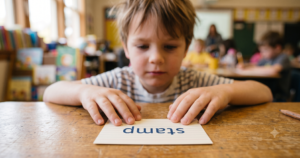
You know those moments when a student comes across a new word, and you can almost see the gears turning in their head as they work to decode it? Or when they’re writing and pause, pencil hovering over the paper, trying to figure out how to spell a tricky word?
These two scenarios might seem different, but they’re actually deeply connected through the relationship between spelling and phonics. Let’s talk about why this connection matters so much for our young readers and writers and how understanding it can transform our instruction.
The Reciprocal Relationship Between Spelling and Phonics
Think of spelling and phonics like two sides of the same coin. When our students read words (decode), they’re using their phonics knowledge to connect letters with sounds. When they spell words (encode), they’re using that same knowledge in reverse, starting with the sounds and figuring out which letters represent them.
As J. Richard Gentry, co-author of Brain Words, puts it so perfectly, “Spelling is at the very foundation of the reading architecture in the brain.”
Here’s what’s fascinating: researchers Nicole Patton-Terry and Carol Connor found that all beginning spellers face the same fundamental challenge – they need to map their speech patterns to print. It’s like they’re building a bridge between what they say and what they see on the page. This connection between spelling and phonics knowledge becomes the foundation for both reading and writing success.
Why Traditional Spelling Tests Fall Short
Now, you might be thinking about those traditional spelling tests we all remember (and maybe still use). You know the routine – hand out the list on Monday, practice writing words ten times each, use them in sentences, test on Friday. I did this for years before I understood there was a better way. The truth is, this approach isn’t giving our students the support they need to develop either their spelling or reading skills.
When we rely solely on memorization for spelling, we miss the opportunity to strengthen the sound-spelling connections that support both reading and writing. Effective spelling and phonics instruction should help students understand patterns and relationships rather than treating words as isolated units to be memorized.
The Research Behind the Connection
Here’s what’s really interesting: some recent research suggests that spending more time on encoding (spelling) activities might actually be more beneficial for reading development than focusing solely on decoding practice. I know – it surprised me too! Studies by Senechal (2023), van Rijthoven (2021), and Conrad (2019) all point to the power of encoding practice for strengthening overall literacy skills.
The relationship between spelling and phonics instruction becomes even more critical when we consider what Linnea Ehri discovered – poor spellers rarely develop into skilled readers. This insight reinforces why we need to give equal attention to both skills in our literacy instruction.