Word Recognition and the Reading Rope: The Three Strands Most Teachers Were Never Taught

The Science of Reading Simplified

If you have built something real in your classroom and you are wondering what teaching phonics systematically would do to everything you’ve carefully built — Carol’s story is the one I keep coming back to. Not because it ends perfectly. Because it ends honestly.
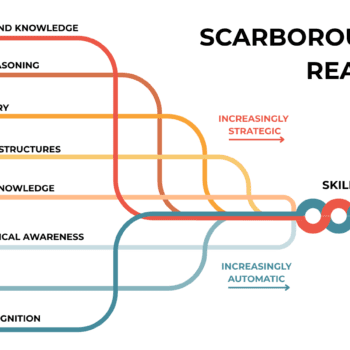
Scarborough’s Reading Rope is a visual model of skilled reading — created by developmental psychologist Hollis Scarborough in 1992 and grounded in decades of research on how reading develops and where it breaks down. If you’ve never had it clearly explained, you’re not alone.

The Simple View of Reading, developed by researchers Philip Gough and William Tunmer in 1986, offers a straightforward way to understand reading comprehension. It’s expressed as a simple formula: R = D × C

You’ve heard the term everywhere lately—at conferences, in Facebook groups, maybe even in a tense staff meeting. “Science of reading” seems to be on everyone’s lips. But if you’re feeling a bit unclear about what is the science of reading (or worried it’s just another education buzzword that’ll disappear in a few years), you’re not alone.

I used to think that bright, eager students who struggled with reading just needed more time or different books to spark their interest. You know the drill—I’d try everything in my toolkit. Easier texts, high-interest topics, even shameless bribery with stickers and extra recess time. But nothing seemed to stick, and I’d find myself lying awake at night wondering what I was missing.

I’ll never forget when everything clicked for me about how reading works in the brain. I was in a professional development session, watching a presenter explain brain scans of children learning to read, when she showed us the Four-Part Processing Model. For the first time, I could see why some students in our schools struggled with reading despite their teachers’ best efforts.

It’s one of those questions that comes up in teacher lounges, professional development sessions, and literacy team meetings: “Is there a place for sustained silent reading in the school day?” If you’ve been teaching for any length of time, you know exactly what I’m talking about—those 15-20 minutes where everyone (teacher included) reads silently.

As a literacy coach, I’ve walked into hundreds of classrooms over the years, and there’s something truly special about turning the corner and finding a teacher deeply engaged in a quality read aloud with their students. Those moments—where eyes are wide, bodies are still, and minds are clearly traveling somewhere else entirely—remind me why I fell in love with teaching literacy in the first place.

If there’s one question I hear constantly in my literacy coaching sessions, it’s this: “How much time should I really be spending on teaching phonics?”
Trust me, you’re not alone in wondering this. As teachers, we’re constantly juggling competing priorities within those precious instructional minutes. And with the renewed emphasis on the Science of Reading, many of us are reevaluating our literacy blocks, especially when it comes to effective phonics instruction.