What Is Scarborough’s Reading Rope?
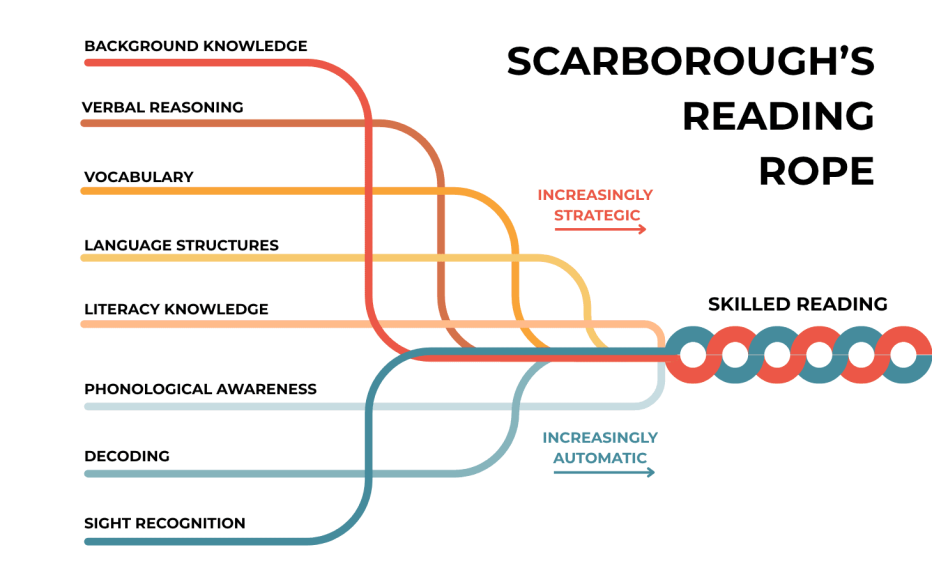
Scarborough’s Reading Rope is a visual model of skilled reading that shows how eight distinct skills, five in language comprehension and three in word recognition, weave together to produce a capable reader. Created by Dr. Hollis Scarborough, it matters for teachers because it reveals not just that a student is struggling, but which specific reading skill is fraying.
The model was born in a surprisingly practical way. In the early 1990s, Scarborough was explaining to parents why learning to read is so complex. She twisted pipe cleaners together to show how different skills intertwine, and the metaphor stuck. The image was published in 2001 in the Handbook for Research in Early Literacy, edited by Susan Neuman and David Dickinson, and has since become one of the most widely referenced frameworks in the science of reading.
The core idea: skilled reading is like a tightly woven rope with two main bundles, language comprehension and word recognition, each made up of individual strands. When every strand is strong and woven tightly together, you get fluent reading with real understanding. When even one strand is weak, the whole rope is compromised.
Why the Reading Rope Matters for Your Students
The Reading Rope matters because it reveals something most of us were never taught: reading is not a single skill that develops on a smooth trajectory. It is a collection of skills that interact and depend on each other from the very beginning.
A student with strong vocabulary and rich background knowledge can look like a solid reader even when her decoding is falling apart underneath. A student who can sound out every word on the page can still understand almost nothing if his language comprehension strands are weak. The rope explains why two students can look so different when both are struggling. Their reading skills are fraying in different places.
This is exactly the insight that was missing from most of our training. Many of us were taught to focus heavily on certain strands, like building background knowledge, expanding vocabulary, and growing a love of books, while the word recognition strands were expected to develop on their own through exposure to text. That was not a teacher problem. It was a training problem, and it affected almost everyone who came up through a balanced literacy program. The Reading Rope makes it impossible to hold that assumption. You can see, right there in the visual, that both bundles matter equally.
Research on the components of skilled reading consistently confirms what the rope illustrates: students need both strong word recognition and strong language comprehension to become skilled readers. When 60% of my intervention students made progress by spring and then came back to my groups the following fall, the rope helped me understand why. We had been strengthening some strands without addressing the ones that were actually fraying.
What the Reading Rope Looks Like in a Real Classroom
Spend a morning watching students read and the Reading Rope is visible everywhere, once you know how to look.
Take Marcus, a third grader reading with easy confidence. His voice has rhythm. His expression is natural. If you were listening from across the room, you would hear a reader. But Marcus is not reading. He is predicting. His strong vocabulary and background knowledge let him guess which words should come next, and his guesses are so plausible that they sound like reading. Where the text says “raced,” Marcus says “ran.” Where it says “swiftly,” he says “quickly.” Every substitution makes perfect sense. None of them are the actual words on the page. His language comprehension strands are doing the work of two bundles. His word recognition strands are barely holding.
Compare him to Tessa, a third grader who is Marcus’s mirror image. Her word recognition strands are solid — she gets the words off the page cleanly, decoding accurately and fluently enough that no one questioned her reading. But her language comprehension strands had quietly lagged behind, and nobody was watching that half of the rope. Background knowledge, vocabulary, verbal reasoning: the strands that make meaning had never been woven tight. The words arrived. The meaning did not follow. Marcus’s rope frays on the bottom; Tessa’s frays on the top. Same rope, opposite halves.
Then there is the student who reads accurately but so slowly that she is exhausted by the end of a page. Her decoding strand may be present but not yet automatic. Every word still costs conscious effort, leaving nothing for comprehension.
When the rope is working, you see a student who reads with accuracy, appropriate speed, natural expression, and genuine understanding, all at the same time. Not because she has one powerful skill, but because many skills are working together so smoothly that none of them is visible.