What “Explicit” Actually Means Here
Explicit phonics instruction is a delivery method: the teacher states the sound-spelling connection directly and models how to use it, rather than expecting students to infer it from exposure, context, or repeated guessing. It matters because the alphabetic code is not something the brain discovers on its own, and a child left to figure it out alone is a child quietly being set up to fall behind.
The word explicit is doing real work there. It means nothing essential is left for the student to guess at: the teacher says the sound, shows how the sounds blend, and demonstrates the exact thing she wants the student to do, out loud, where the student can see and hear it. The opposite is implicit instruction, which surrounds a child with books and language and trusts that the rules of print will surface on their own. Some children do seem to pick it up that way. Most do not, and the ones who don’t are rarely the ones raising their hands to say so.
Why the Showing Is the Point
Reading is not natural the way talking is. Children grow into spoken language by being immersed in it, but written language is a code somebody invented, and the brain has no built-in circuit waiting to crack it. Marilyn Adams made this case in Beginning to Read: the path runs from direct instruction in the code, to a working link between the letters and the sounds they stand for, to automatic word recognition, and only then to comprehension. Skip the first step and the rest of the chain never forms.
This is why the modeling can’t be treated as a warm-up you rush through to get to the “real” practice. The modeling is the instruction. When a teacher shows the move first, the student doesn’t spend energy figuring out what the task even is. That energy goes straight to the move itself. The research backs the showing. The National Reading Panel’s meta-analysis, published by Ehri and colleagues, found that systematic, explicit phonics instruction produced stronger reading outcomes than instruction that left the code implicit, with the largest gains in the earliest grades. The federal practice guide on foundational reading lands in the same place, naming explicit letter-sound instruction as a core recommendation.
Most of us were never taught this part. Explicit-instruction technique was a thin chapter, if it appeared at all, in the program that prepared us to teach reading. That’s a gap in the training, not a gap in anyone’s care.
What This Looks Like in the Room
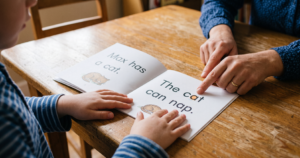
If you watched explicit phonics instruction happening well, you’d see a rhythm with three beats: I do, we do, you do.
I do. The teacher goes first. She holds up the spelling, says the sound (the sound, not the letter name), and models blending a word aloud while the students watch: /m/ /a/ /p/, map. She isn’t quizzing yet. She’s demonstrating.
We do. The teacher and students do it together. She points, they say each sound with her, they blend it as a group. If a sound wobbles, she catches it and models it again. Nobody is on the spot alone.
You do. The student does it independently while the teacher watches. This is the beat Theo reached when I stopped reading and just pointed. The handoff is gradual on purpose. The support comes off one layer at a time, so that by the time a child is reading a word by himself, he has already heard it modeled and practiced it with help.
Explicit phonics instruction is one piece of a larger, planned approach to teaching the code, and how those pieces fit together is covered in systematic phonics instruction. What you would not see in a strong explicit lesson is a child told to look at the picture, skip the hard word, or guess what would make sense. You’d see a teacher showing, then sharing the work, then stepping back.
And here is the thing worth sitting with. When the support came off and Leo had read six words in a row, he went completely still. Not the stillness of a kid concentrating hard. The still of a six-year-old quietly revising what he thought he was capable of. The modeling is what got him there. Not a worksheet, not a sticker, not more time near books. Someone showed him the move, and then let him make it himself.