What This Looks Like in Practice
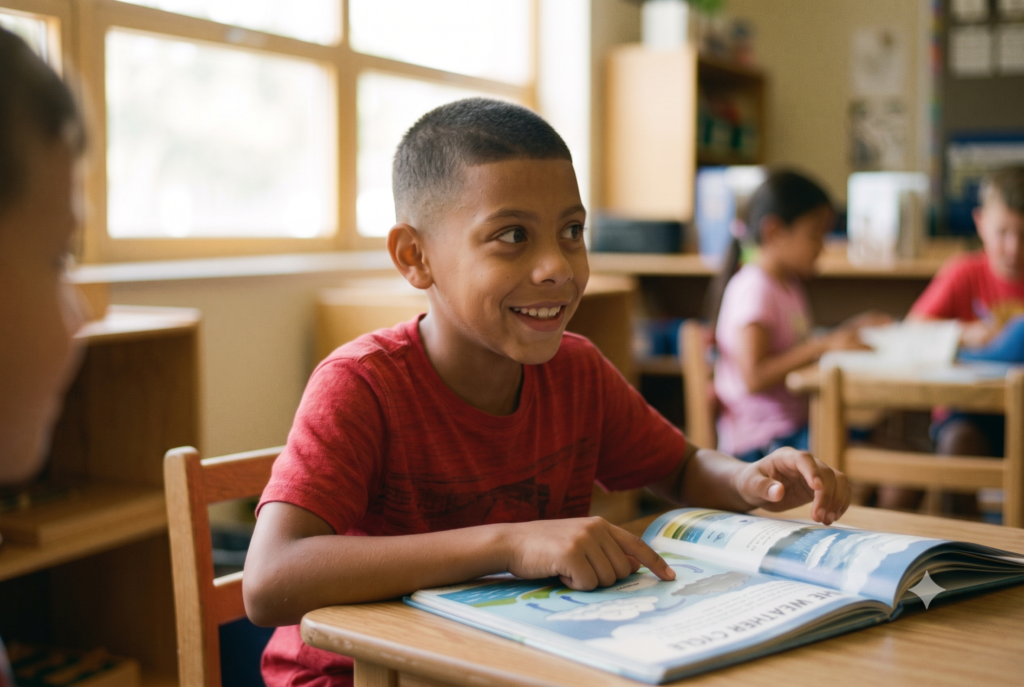
I once worked with a third grader I’ll call Miguel. Isaac could decode. He read aloud with reasonable accuracy and fluency, and his oral vocabulary was fine for conversation. But his comprehension swung wildly by topic. Strong on the subjects he knew, near the floor on the ones he didn’t. On a water cycle passage, he read every word correctly and then, asked what it was about, said, “Water, I think. Like, how it moves.”
After a coaching conversation, his teacher tried something before the next science unit on weather and climate. For about ten minutes before each reading passage, she showed a short video clip, led a brief discussion, and pre-taught three vocabulary words with pictures and kid-friendly meanings. Same text, same questions. She only changed what Miguel knew walking in.
His comprehension on the weather passages was markedly better than it had been on the water cycle. Afterward she said to me, “It’s like he was a different reader.” He wasn’t a different reader. He was the same reader with different knowledge.
And here’s what’s worth holding onto: that teacher wasn’t starting from scratch, and neither are you. If you already preview books with your class, talk about the cover, ask what students think a text might be about, you’re already doing the foundation of this work. The routine below makes those instincts deliberate and aims them at the text in front of you.
Pre-Reading Strategies: The Routine, Step by Step
Pre-reading strategies are short moves you make right before students read an unfamiliar text, to surface what they already know and quickly supply what they’re missing. They matter because comprehension is an act of connection: a reader can only link new text to knowledge that’s already there, and when it isn’t, you can hand it over in minutes.
Here are four moves, about ten minutes, before reading.
1. Preview the text. Orient students to what they’re about to read and how it’s built. For younger readers, this is a picture walk: flip through, look at the illustrations, name what they notice. For older readers, a quick skim of the title, headings, and any charts. You’re building a mental map of the territory before they walk into it.
2. Surface and supply the knowledge. This is the heart of it, and it’s two jobs, not one. Surface what students already know about the topic, and quickly supply what they’re missing: a two-minute discussion, a short video clip, an anticipation guide where students agree or disagree with a few statements. The supplying half is the one teachers skip most, and the one struggling readers need most, because activating only works if there’s something there to activate.
3. Front-load two or three make-or-break words. Not every hard word. The two or three the text collapses without. Teach them fast, with a kid-friendly meaning and a picture. If a passage hinges on evaporation and the reader has no idea what it means, no comprehension strategy will rescue them. Pick the words that carry the text and hand those over first.
4. Set a purpose. Give students one thing to read for — a question to hold, something to find. This keeps thinking switched on the whole way through, instead of letting students read straight past the meaning.
That second move, surfacing and supplying, is activating prior knowledge, and it works because of how background knowledge functions in comprehension. For the research behind why a few minutes of activation changes what a reader can understand, background knowledge explains it in full. This sequence draws on Daniel Willingham’s How Knowledge Helps and E. D. Hirsch’s Building Knowledge, both free and written for teachers.
One of my favorite versions of this I walked in on by accident. The teacher opened every text with a story, sometimes from her own life, sometimes one she’d invented, to set the scene for what they were about to read. The students were captivated. What I loved was that instead of a standard KWL chart, where you’re never quite sure what students will surface, she used the story to ask careful questions aimed straight at the text. Even when a student didn’t know an answer, there was a hook they could relate to, followed by a question that kept them thinking the whole time they read. That’s activating and purpose-setting in one warm move.
What You’ll Notice When It’s Working
You don’t need a rubric to know your pre-reading strategies are working. You’ll see it in the retell. A student who used to give you “it was about water, I think” starts giving you the actual gist, naming what happened and using a word or two you front-loaded. The vocabulary you pre-taught shows up in their answers, which tells you it went in and stuck.
You’ll notice students reaching back to the discussion you had before reading. Mid-passage, a hand goes up: “This is like what we talked about.” That’s a reader connecting new text to knowledge you just made available — exactly the move comprehension depends on. You’ll feel it in the room, too: less stalling, fewer students drifting where an unfamiliar concept used to lose them. With a purpose set, they read toward something instead of reading until the page ends.
And here’s the one that surprised me most: students you’d assumed had a comprehension problem start comprehending. Not because their reading skill changed in ten minutes, but because the gap was never in the reading. It was in what they knew before they started. Close that gap up front, and the reader you thought you had turns out to be stronger than the data showed.