Marcus reads the sentence with easy confidence: “The dog ran quickly to his house.” His voice has natural rhythm. His expression doesn’t change. He sounds like a strong reader — and if you’re listening for comprehension, he is.
Except the text says: “The dog raced swiftly to his home.”
Every substitution preserves the meaning perfectly. “Ran” for “raced.” “Quickly” for “swiftly.” “House” for “home.” You almost miss it entirely. You almost did.
After the group, you write “raced” on an index card and hand it to Marcus. He looks at it for longer than he should. Letter by letter, carefully: “r-a-c-e-d… raced.” Eight seconds. For a word he just “read” four minutes ago.
That eight-second gap is the word recognition side of Scarborough’s Reading Rope — and it’s the half of reading instruction that most of us were never explicitly trained to teach.
What Is Word Recognition in the Reading Rope?
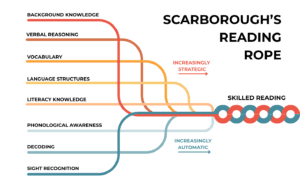
Word recognition is one of two major bundles in Scarborough’s Reading Rope model, and it includes three distinct strands: phonological awareness, decoding, and sight recognition. Together, these three strands represent a reader’s ability to accurately and automatically identify printed words.
Here’s what each strand actually does:
Phonological awareness is the auditory foundation — the ability to hear and manipulate individual sounds inside spoken words. Before a child can connect letters to sounds, they need to hear that “cat” is made of three separate sounds.
Decoding is the alphabetic bridge — understanding that letters and letter patterns represent specific sounds, and using that knowledge to read unfamiliar words. This is the strand most teachers think of when they hear “phonics.”
Sight recognition is the end goal of the bundle — recognizing familiar words instantly, without sounding them out. This isn’t memorization. It’s what happens when a word has been decoded accurately enough times that the brain stores it for automatic retrieval — a process researchers call orthographic mapping.
These three are not the same skill at different levels. They’re distinct abilities that develop in relationship to each other, and all three need to be strong for word recognition to work.
Why Word Recognition Matters More Than You Might Think
The most important thing Scarborough’s model shows about the word recognition strands is the direction they’re heading: toward increasing automaticity. Word recognition doesn’t just need to be accurate — it needs to be so fast and effortless that the reader isn’t even aware it’s happening.
This is the mechanism behind a pattern you’ve probably seen: the student who reads every word correctly but can’t tell you what the passage was about. When word recognition isn’t automatic — when every word still requires conscious effort, even if that effort produces the right answer — there’s nothing left for comprehension. Working memory is fully occupied with the words themselves.
Marcus doesn’t look like he’s struggling. His language comprehension is genuinely strong, and he uses it to compensate for word recognition that hasn’t become automatic. He predicts words from context so seamlessly that the gap is invisible — until you put a single word on an index card and take away everything else.
If you want to understand how word recognition fits into the full picture of all eight strands, Scarborough’s Reading Rope model shows how the word recognition bundle and the language comprehension bundle work together — and why both need to be strong.