So What’s the Difference Between Phonemic Awareness and Phonics?
Phonemic awareness is the ability to hear and manipulate the individual sounds in spoken words. Phonics is the ability to connect those sounds to printed letters. The distinction matters because when phonics instruction isn’t working for a student, the problem is often upstream: the sound awareness that phonics depends on hasn’t been built yet.
Phonemic awareness lives entirely in spoken language. When a child segments the word “dog” into /d/ /o/ /g/, she’s doing phonemic awareness work. No print. No letters. Just sounds.
Phonics is where print enters the picture. When a child sees the letters d-o-g and maps each one to a sound, then blends those sounds into a word, that’s phonics. It requires knowing that specific letters represent specific sounds.
Here’s why the distinction matters: phonemic awareness is the foundation that phonics is built on. If a child can’t hear the three separate sounds in “cat,” knowing that the letter c makes the /k/ sound doesn’t help her. The letter-sound knowledge has nowhere to land.
Most of us were never taught this distinction clearly. Credential programs treated phonemic awareness and phonics as roughly the same thing, or moved through phonemic awareness so quickly that the difference never registered. That wasn’t a personal failure. It was a gap in teacher training for decades. And it’s a gap worth closing, because it changes what you look for when a student is stuck.
Why This Matters When Phonics Isn’t Working
When you’re teaching phonics and a student isn’t making progress, the instinct is to reteach the phonics: more practice with letter-sound correspondences, more blending drills, more repetition. Sometimes that’s exactly what’s needed.
But sometimes the problem isn’t the phonics. It’s upstream.
A child who can’t isolate the /m/ in “mat” doesn’t need more letter-sound practice. She needs someone to help her hear that “mat” is made of three distinct sounds in the first place. The phonemic awareness, the ability to attend to individual sounds within a spoken word, isn’t there yet. And until it is, phonics instruction is building on a foundation that doesn’t exist. David Kilpatrick describes this clearly in Equipped for Reading Success: phonics is the print connection, but it only works when the oral foundation is in place.
This is what Maya’s spelling test revealed. She had the letter knowledge. She didn’t have the sound awareness to use it.
If you want to understand what phonemic awareness is and how it develops, the full picture matters. For right now, the most important takeaway is this: when phonics instruction isn’t landing for a particular student, checking their phonemic awareness is the first diagnostic move.
What This Looks Like in the Classroom
Maya’s spelling test shows what happens when the foundation is missing. But it’s just as important to see what it looks like when these two skills are working together, because in good instruction, they aren’t separated into months of one followed by months of the other. They overlap.
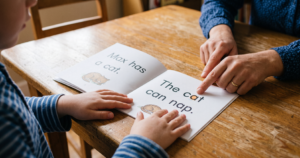
Picture a small group of kindergartners. The teacher says “sat” and asks students to tap out each sound on their fingers: /s/ /a/ /t/. Then she asks them to match each sound to a letter tile and push the tiles together. Same word, same minute, two different cognitive tasks. The two skills are reciprocal, each strengthens the other. The National Reading Panel’s meta-analysis of 52 studies (Ehri et al., 2001) found that phonemic awareness instruction produces larger effects when it’s taught with letters than without.
A kindergarten teacher I was coaching last year came to me stuck. Her class had started blending and spelling, and most students were getting it. Her most reliable speller was a boy who nailed every practiced word: mat, sat, cat, at. But the moment the class moved past the first set of letters and sounds, his spelling fell apart, even though he knew every new letter and its sound.
I asked whether she had checked his segmenting. She wasn’t sure. She came back a few days later: he could hear the letters, he could blend, but when she asked him to break a word into its sounds, he couldn’t. And that was the moment it clicked for her. If he couldn’t stretch a word and hear the individual sounds, of course he couldn’t spell it. The phonics wasn’t the problem. The segmenting was.
The point of understanding the difference isn’t to build a wall between them in your teaching. It’s diagnostic. When a student is stuck on phonics, or when spelling errors look like Maya’s, knowing that phonemic awareness is a distinct skill tells you where to look.