Compound Words: The First Step Toward Teaching Your Students How Words Work

Jaylen is sitting in front of you during a second-grade word study group, and you’ve written “doghouse” on the whiteboard. He reads it slowly: “dog… house. Doghouse.” Then he stops. Looks at the word again. Looks at you.

“Wait. Is that just ‘dog’ and ‘house’ stuck together?”

You nod.

“So it’s like… a house for a dog?”

You nod again. And something shifts behind his eyes, not surprise exactly, but the particular focus of a seven-year-old who has just noticed something about how language works that no one has pointed out to him before.

“Can you do that with other words?”

After years as a reading interventionist and Academic Coach working with readers in grades K–5, I’ve learned to pay attention to that question. Because can you do that with other words? is the whole reason compound words matter. Not because students need to memorize a list for a Friday quiz. Because compound words are the first time most students encounter a concept that will change how they read for the rest of their lives: words are built from parts, and those parts carry meaning.

What Are Compound Words?

A compound word is a word made of two or more smaller words that can each stand on their own, joined to create a new meaning. Sunflower. Butterfly. Backpack. Compound words matter because they’re the first place students see that words are built from meaningful parts: the insight every later morphology skill depends on.

Each of those smaller words, sun, flower, back, pack, is what reading researchers call a morpheme: the smallest unit of meaning in a language. When two morphemes that can stand on their own combine, you get a compound word.

What makes compound words special is that they’re transparent. Your students already know what “sun” means. They already know what “flower” means. When they see those two words joined together, they can use what they already know to figure out the new word. That’s not just a vocabulary skill. That’s morphological thinking, the ability to notice and use meaningful parts inside words.

And that kind of thinking is exactly what students need when words start getting longer and more complex.

Why Compound Words Matter for Reading

The first time I really saw this land was when I was modeling a compound-words lesson for a kindergarten teacher. We didn’t start with a worksheet. We started with our phonological awareness routine, blending and segmenting compound words by ear. Cow… boy. Cowboy. Now take away boy. What’s left?

That opened a conversation I didn’t expect from five-year-olds: a word can stand on its own and also be part of a bigger word, and when you combine two of them, you make something new. We used picture cards to show it. A cow, a boy, then a cowboy. The new word had a new meaning, but the kids could still see how it was tied to the smaller words inside it. That’s the whole principle, arriving through the ear before they ever had to read it.

The larger skill is morphological awareness: the ability to recognize that words contain meaningful parts and to use those parts to figure out unfamiliar words. Research by Joanne Carlisle found that this awareness predicts both vocabulary knowledge and reading comprehension by third and fifth grade (Carlisle, 2000). And a meta-analysis by Bowers, Kirby, and Deacon confirmed that morpheme-focused instruction benefits reading outcomes, particularly for struggling readers (Bowers, Kirby & Deacon, 2010).

Compound words are where that awareness starts. A first grader who understands that “doghouse” is “dog” plus “house” has grasped the foundational principle: I can break words into meaningful parts to figure out what they mean.

That same principle is what makes prefixes, suffixes, and roots accessible later. Nagy and Anderson estimated that around 60% of the unfamiliar words a reader meets have meanings that can be predicted from their parts. The fourth grader who encounters “uncomfortable” and knows to look for parts — un-, comfort, -able — is using the exact morphological thinking that started with compound words. If she never learned to look for parts, the longer word is just a wall.

For a deeper look at how morphology fits into reading instruction and why it matters, compound words are the first chapter of a much bigger story. But they’re the chapter that makes the rest of the story possible.

What This Looks Like in a Classroom

Most compound words follow a pattern your students can learn: the second word names the category. A doghouse is a type of house, not a type of dog. A blueberry is a type of berry. A birdhouse is a type of house, but a housedog is a type of dog. By second grade, many students pick up on this pattern intuitively. But “intuitively” isn’t the same as “explicitly,” and explicit is where the instructional power is.

Start with words your students already know. Write “sunflower” on the board. Ask what they see inside it. When they find “sun” and “flower,” ask: What does each part tell us about the whole word? Then try it with “raindrop,” then “football.” Each time, you’re reinforcing the same habit: look inside the word, find the parts, use what you know.

None of this asks you to abandon the word study you already do. It asks you to add one question to it.

Then name what they’re doing, because this is the step that matters most. You just figured out a word by looking at its parts. That’s something good readers do with all kinds of words, not just compound words. That one sentence lays the groundwork for every morphology lesson that will follow.

The Misconception That Keeps Compound Words Small

There’s a common assumption that compound words are a primary-grades skill students don’t need explicit instruction in, that they’ll figure it out through exposure. And it’s true that most second graders grasp the meaning of familiar compound words without being taught.

But the point isn’t whether Jaylen knows what “doghouse” means. He probably does. The point is whether he knows why he knows, whether he’s aware that he used the parts of the word to get to the meaning, and whether he can do the same thing on purpose when the words get harder.

Without explicit instruction, the transferable principle stays invisible. Compound words become an isolated worksheet skill rather than the beginning of a word-analysis system. The student who matched “dog” and “house” on a worksheet in second grade arrives in fourth grade without any strategy for “uncomfortable” or “independence” or “photosynthesis,” because nobody ever said: The thing you just did with compound words? You can do that with all words.

What This Means for Your Teaching

You don’t need a new curriculum to teach compound words as morphology instruction. You need a shift in framing. The next time compound words come up in your word study block or your shared reading, try this.

After students identify the two words inside a compound word, pause. Ask: How did knowing the parts help you figure out the whole word? Then tell them: That’s exactly what readers do when they come to a word they don’t know. They look for the parts they recognize.

That’s one sentence. It takes five seconds. And it connects a familiar activity to a reading strategy your students will use for the rest of their lives.

Key Takeaways

  • Compound words join two standalone words (morphemes) to create a new meaning, the most transparent example of how words are built from parts.
  • Teaching compound words as morphology, not just vocabulary, builds morphological awareness, which research links to vocabulary and comprehension gains.
  • Most compound words follow a learnable pattern: the second word names the category (a doghouse is a type of house).
  • Compound words are the instructional bridge to prefixes, suffixes, and roots, the same “look for parts” strategy transfers directly.

All student and classroom examples in this post are composites drawn from the author’s professional experience. Names and identifying details have been changed. No example represents a single identifiable student.

Hello!

My Mission is Simple

Give teachers the science-backed tools they need to help every student become a confident reader.
I’m so glad you’re here! 

Where to Go From Here

Give me the Quiz!

If compound words are the first chapter in how words work, Jaylen’s question, can you do that with other words?, is the right one to follow. The answer is yes. If you’re noticing gaps between what you were trained to teach and what your students actually need, you’re not alone. I spent years running compound word activities without connecting them to anything larger. Download the free guide: 5 Silent Signs Your Students Are Struggling to Read

Where This Research Comes From

Recommended Reading

Research Sources

As an Amazon Associate, I earn on qualifying purchases.

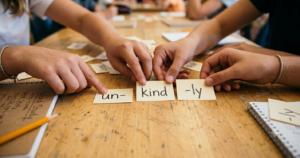
Two students lean over their desks to arrange morpheme cards showing "un-," "happy," and "-ness" together, building words from their parts during a morphology activity.
Science of Reading

What Is a Morpheme? The Word-Building Block Most Teachers Were Never Taught

A morpheme is the smallest unit of meaning in a word. Not the smallest unit of sound; that’s a phoneme. Not the smallest pronounceable chunk; that’s a syllable. A morpheme is the smallest piece of a word that carries its own meaning. We spent years teaching students to break words into syllables for decoding. Syllables help students pronounce long words. But morphemes help them understand long words, and that’s a different skill entirely.

Read More »

Grab your free lesson plan!

You're Just a Click Away!