He Knows Letters. So Why Can’t He Read?

Oliver knows letters – names and sounds.

All of them. He can sing the alphabet forward and backward, and he beams every time you hold up the letter O card and he calls out “orange” before anyone else in the circle. He loves the alphabet strip running above your whiteboard. He knows every shape, every name, every sound you’ve told him each letter makes.

By every visible measure, Oliver is exactly where a kindergartner should be.

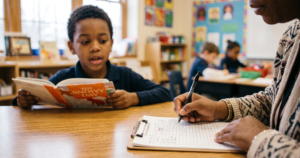
So why, when you sit beside him with a simple book and point to the word “chair,” does he look at the picture of a cat perched on a chair — and say “sit” with complete, untroubled confidence?

And later, when you find “chair” in a different book, on a page where the illustration shows a table and no chair at all — Oliver looks at the picture for a long moment, looks back at the word, looks back at the picture. He says nothing. He turns the page.

No distress. No “I don’t know.” Just absence. The marks on the page don’t mean anything to him, and he has learned, somewhere along the way, not to expect them to.

If you have a student who knows letters but can’t seem to read unfamiliar words, you already know the particular confusion of watching a child do everything right and still not get there. He’s not struggling with effort. He’s not disengaged. He knows his letters. So what’s happening?

When a Student Knows Letters But the Words Don’t Come

Here’s what teachers often say about a child like Oliver: He knows his alphabet. He just needs more time. He’s not quite ready yet.

And those things feel true — because Oliver does know his letters. The problem is that knowing letter names and knowing how to read are two entirely different skills, and nothing in Oliver’s classroom experience has made that distinction visible to him. Or, honestly, to anyone watching him.

What Oliver is doing when he “reads” is constructing the most reasonable answer from every clue available: the picture, the shape of the sentence, the first letter of a word, and whatever the story seems to be about. It’s actually quite sophisticated. It just isn’t decoding.

What a student who knows letters but can’t read a new word is missing is a system — a way to take an unfamiliar word apart, move through it left to right, and arrive somewhere reliable. Oliver knows that O says “orange.” But he doesn’t know what to do when O shows up in the middle of a word he’s never seen before. He knows letter names the way a tourist knows landmark names: useful for orientation, not useful for navigating the language.

This pattern is invisible to most of the tools you’d use to check in on reading. Oliver looks engaged. He participates. He “reads” along with expression and enthusiasm. The running record doesn’t catch it because Oliver is smart enough to make the text work — until the picture and the context run out, and all that’s left is the word.

You didn’t miss Oliver because you weren’t paying attention. You missed him because the tools around you weren’t built to catch this.

Why a Child Who Knows Letters Still Can’t Decode New Words

Think about learning a musical instrument. You could spend months memorizing the names of every note — every key on the piano, every position on the staff. You’d be genuinely impressive at naming them. But sit down to play a song, and you’d have no idea what to do, because naming notes and reading music are not the same skill. The bridge between them is learning how the notes combine, how they move in sequence, how one flows into another.

Letter knowledge works the same way. A child who knows letters by name has one piece of a much larger puzzle. Knowing that the letter C is called “see” gives Oliver almost nothing useful when he meets the word “chip” — because “chip” requires him to hear three separate sounds, connect each one to a letter or letter pair, and blend them back together in order. That’s decoding, and it has to be taught directly, cumulatively, with each piece building on the last. It doesn’t emerge automatically from letter exposure, no matter how solid that letter knowledge is.

A student who knows letters but hasn’t been taught to blend them has been handed the ingredients without the recipe. Of course he reaches for pictures. Of course he reaches for context and memory and the first letter as a guess. He is doing exactly what any of us would do if asked to navigate a written language we’d never been shown how to crack — using every available clue except the one nobody gave him.

Every classroom has an Oliver. He is the child who learned everything he was taught and still couldn’t read — not because anything is wrong with him, and not because his teacher failed him, but because the instruction he received was never designed to build a decoding system. The teachers who find him are the ones looking closely enough to notice the distance between what he knows and what he can do.


He Knows Letters. So Why Can't He Read?

What This Tells You About Where Oliver Actually Is

A student who knows letters but can’t read unfamiliar words doesn’t have a reading problem in the way we usually mean that phrase. He has an instruction gap — specific, identifiable, and closeable.

What Oliver knows: letter names, how to use pictures, how to use context, how to make a plausible guess, how to make reading look like it’s happening. These are real skills. They just aren’t the right ones for decoding.

What Oliver doesn’t yet know: how to move through an unfamiliar word systematically — left to right, sound by sound — until it becomes something he can say and recognize. That’s what’s missing. Not intelligence. Not effort. Not readiness. A specific set of skills that have to be taught in sequence.

This might bring up something uncomfortable — especially if you’ve been running letter-of-the-week activities, which are genuinely good at building letter familiarity. They were designed to do exactly that. What they weren’t designed to do is build the cumulative, connected phonics system that turns letter knowledge into decoding. That’s not a flaw in the approach so much as it’s a gap in the job description. The tool did what it was built to do. It just wasn’t built to do everything reading requires.

Oliver doesn’t need more letter exposure. He needs to learn what to do with the letters he already knows — how to hear the sounds in a word, connect them to print, and blend them back into something readable. That instruction exists. It’s specific, it’s teachable, and a child like Oliver — enthusiastic, engaged, genuinely wanting to do this right — can move quickly once he has it.

One Thing to Notice This Week

Think about Oliver. Or whoever your Oliver is — the student who knows his letters, participates cheerfully, and still can’t get traction when an unfamiliar word appears.

This week, find a word from a book he’s recently “read.” Write it alone on a sticky note. No picture. No surrounding sentence. Just the word.

Hand it to him and watch the first two seconds. Does he glance for a picture that isn’t there? Does he take a guess from the first letter? Does he go quiet in that particular way that means the print isn’t offering him anything?

That moment will tell you more about where this student actually is as a reader than a month of running records. You’re not looking for a right or wrong answer. You’re looking for what strategy he reaches for — and whether the letters themselves are doing any of the work.

Key Takeaways

  • A student who knows letters by name has built letter familiarity — not a decoding system. Those are two different things, and one doesn’t automatically lead to the other.
  • When a child knows letters but can’t read new words, he’s missing the instruction that connects letter knowledge to blending — the bridge has to be explicitly taught.
  • Children who can’t decode yet will use every available clue: pictures, memory, context, first letters. This is intelligent problem-solving, not laziness or lack of effort.
  • The students who fall through this gap are often enthusiastic and engaged — nothing in their behavior signals that something is missing.
  • A single word on a sticky note, removed from pictures and context, reveals what a running record can’t: whether the letters themselves are doing any work.

The students in this post are fictional composites — built from real patterns I’ve observed across twenty years in classrooms and reading intervention. The names and details are invented. The behaviors are real.

Hello!

My Mission is Simple

Give teachers the science-backed tools they need to help every student become a confident reader.
I’m so glad you’re here! 

Give me the Quiz!

Feeling Stuck?

If Oliver’s story felt familiar, there’s a good chance you’re already seeing other signs — the ones that are easy to overlook when a student seems happy and engaged. My free guide, 5 Silent Signs Your Students Are Struggling to Read, walks you through exactly what to watch for, so you can find these students before the gap has years to grow.

Additional Resources

These are the books that have earned a permanent spot on my teacher bookshelf—dog-eared pages and all—that might be helpful as you implement these strategies.

As an Amazon Associate, I earn from qualifying purchases.

What is listening comprehension?
Science of Reading

What Is Listening Comprehension — And Why It Matters More Than Most Teachers Realize

It is read-aloud time, and the class is discussing a picture book about a child who moves to a new country. The conversation is rich. Students are connecting to the character, predicting what will happen, noticing the illustrator’s choices. Nadia is sitting quietly in the second row, looking at the pictures. Her teacher asks, “Why do you think Amelia feels nervous about her first day at school?”

Read More »

Grab your free lesson plan!

You're Just a Click Away!