Why Is Reading Fluency Important? The Skill Most Often Mistaken for Something Else

Darius was a fifth grader who had made peace with not being a reader. He told me so himself, in the calm voice of a kid who had thought it through. “Reading’s just not my thing. I’m more of an audio person.” I had been sitting near him during silent reading for half an hour, not to test him, just to watch. In that whole stretch he turned four pages. At one point his eyes settled on the same two lines near the bottom of page forty-three, and they stayed there for a good twelve minutes. Not the focused stillness of a kid working through a hard sentence. The patient stillness of a kid waiting out a clock.

After years as a reading interventionist and Academic Coach working with struggling readers across grades K through 5, I can tell you that nobody in Darius’s life had ever called this a fluency problem. His teachers thought he was an auditory learner. So did he. And I’ll be honest, early in my career, I might have believed him too.

A kid who reads every word correctly and just prefers to listen does not look like a problem you need to solve. That is exactly why reading fluency is so important — more than most of us were ever taught. Fluency is the reading skill most likely to get mistaken for something else, and when we misname it, we stop looking for the thing we could actually fix.

The Skill That Hides Behind Other Names

Reading fluency is the ability to read with accuracy, at an appropriate pace, and with expression, so that a reader’s attention is free for meaning rather than spent on the words. It matters because a fluency gap rarely announces itself as one. It shows up wearing other names, and each wrong name sends a teacher looking in the wrong direction.

You have probably met these students without knowing what you were looking at. One gets described as “just a slow reader,” as though slowness were a personality trait rather than a sign. Another “doesn’t like reading,” and his avoidance looks like attitude when it is actually exhaustion. A third “rushes and doesn’t care.” And then there is the one, like Darius, who has built a whole identity out of being an audio person. Different labels, and underneath several of them, the same unnamed gap.

Here is why the misnaming is so easy. A student with a decoding gap stumbles over words, and the problem is visible. A student with a fluency gap often reads every word correctly. Nothing looks broken. He is accurate, quiet, compliant, and working harder than anyone in the room to produce reading that sounds flat and effortful. The cost is real, but you can’t see it unless you know to listen for it. So we reach for the explanation we can see, and “he’s not a strong reader” becomes the file we put him in.

Why Reading Fluency Matters: The Cost of a Misnamed Gap

When a fluency gap gets called something else, it doesn’t get taught. And a fluency gap that doesn’t get taught does not sit still. It compounds.

Researchers have a name for this widening. Keith Stanovich called it the Matthew Effect, after the line about the rich getting richer, and once you see it in a classroom you cannot unsee it. A student who reads with ease reads more, because reading is not painful. More reading means more words met, more vocabulary, more knowledge, stronger comprehension, more willingness to pick up the next book. A student who reads with effort reads less, because every page costs him something, and the thinner vocabulary and slipping confidence follow from there. The gap between the two readers does not hold steady from year to year. It grows.

This is why fluency matters most, and it gets discussed least. By the time a struggling reader reaches fifth grade, the original gap has had years to widen, and it has usually picked up a story along the way. “I’m not a reader.” “I’m more of an audio person.” Those are not lies. They are the accurate, hard-won descriptions of how a child has learned to survive in a world where reading is too hard.

Darius believed his completely. He had earned it, one labored page at a time, while the thing underneath went unnamed. If you want to understand the full mechanism what reading fluency actually is and how it works lays it out. But the thing I most want you to hold onto is the stakes: a gap nobody names is a gap nobody closes.

One misconception makes the misnaming worse than it has to be: the belief that fluency means reading fast. It doesn’t, and the confusion does real damage. Rate is one part of fluency, but “appropriate” is the word that matters. A child who races through a passage in a flat, breathless rush is not fluent; he has learned to value finishing over understanding.

A teacher who believes fluency equals speed will push a struggling reader to go faster, watch it not help, and conclude the child simply isn’t strong at reading. The real gap goes unaddressed because it was never named correctly. Fluency was never a race. It is reading that sounds like language, at a pace that lets meaning keep up.

Why So Many of Us Never Learned to See It

If you are realizing you have a few students who fit this description and you were never taught to spot them, I want to be clear about something. That is not a gap in your care. It is a gap in the training most of us received.

Balanced literacy, the approach a lot of us were credentialed in, largely treated fluency as something that would take care of itself. The belief was that if students just kept reading, fluency would come, and for the students already on track, it often did. But “just keep reading” was never a plan for the students who needed something more deliberate, and it left a generation of teachers without a clear picture of what fluency is, how to hear it, or how to build it.

As a reading interventionist, I watched reading volume alone move the students who were already fluent and quietly fail the ones who weren’t. The kids who most needed fluency instruction were the least likely to get it from more independent reading time.

I’ll say the part the skeptic in all of us needs to hear. None of this means the joyful, book-loving classroom you’ve built is the problem. Skill and joy are not enemies. A child reads for pleasure more readily once reading stops costing him everything, and that is an argument for naming the fluency gap, not for loving books less.

What This Means for Your Teaching

Here is one thing you can do this week, and it asks nothing more than your attention.

Sit beside one student during independent reading, the one you have quietly wondered about, and just listen. No timer. No running record form. Listen to how the reading sounds. Does it move in natural phrases, or does it come one effortful word at a time? Does he pause where the meaning pauses, or stop in odd places? You are not assessing. You are checking whether the label you gave this child might have the wrong name on it.

And here is the honest part. Recognizing a fluency gap when you hear it is a real step, and it is not the same as knowing how to close it. Hearing the gap and being equipped to teach into it are two different things, and that distance is closeable, with the right training and a clear path. Naming the thing correctly is where it starts.

Key Takeaways

  • Reading fluency is the skill most often mistaken for something else, which is why a fluency gap so often gets filed under “slow reader,” “not a reader,” or “more of an audio learner.”
  • A misnamed gap doesn’t get taught, and an untaught fluency gap compounds year over year through the Matthew Effect until a struggling reader builds an identity around it.
  • Fluency is not reading fast; pushing a struggling reader toward speed misses the real gap and can deepen the confusion about what fluency even is.
  • Most of us were never taught to spot fluency gaps because the training treated “just keep reading” as the plan, and reading volume alone doesn’t move the students who need fluency support most.

All student and classroom examples in this post are composites drawn from the author’s professional experience. Names and identifying details have been changed. No example represents a single identifiable student.

Hello!

My Mission is Simple

Give teachers the science-backed tools they need to help every student become a confident reader.
I’m so glad you’re here! 

Where to Go From Here

Give me the Quiz!

If a student came to mind while you were reading this — the one whose struggle you have never quite been able to name — that recognition is worth following. I put together a free guide called 5 Silent Signs Your Students Are Struggling to Read. The fluency gap that hides behind other names is one of those silent signs, and the guide walks you through the rest, so you know exactly what to watch and listen for in your own classroom.

Where This Research Comes From

Recommended Reading

Research Sources

As an Amazon Associate, I earn on qualifying purchases.

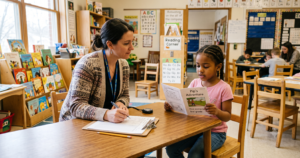
Teacher listening closely as an elementary student reads aloud from a chapter book at her desk in a classroom library setting
Science of Reading

What Is Automaticity in Reading? Why Accurate Readers Still Struggle

Automaticity in reading is the ability to recognize words instantly and effortlessly, without conscious attention, so the brain’s limited resources are free for understanding rather than spent on decoding. Without it, accurate reading stalls before it ever reaches comprehension, no matter how correctly a student sounds out each word.

Read More »
Teacher scoring a clipboard while a student reads aloud during an oral reading fluency assessment
Science of Reading

How to Do an Oral Reading Fluency Assessment (And What the Score Means)

Oral reading fluency assessment is a one-minute, one-on-one reading probe in which a student reads aloud from an unpracticed, grade-level passage while you track errors and calculate a words-correct-per-minute (WCPM) score. That score gets compared to nationally normed benchmarks (specifically the Hasbrouck and Tindal compiled ORF norms) to tell you whether the student is on track, needs monitoring, or needs intervention.

Read More »
A teacher takes notes while a young student reads aloud from a book, capturing a moment of oral reading fluency practice.
Science of Reading

Oral Reading Fluency: What That One-Minute Assessment Is Really Telling You

Oral reading fluency is the ability to read text aloud with accuracy, an appropriate rate, and expression. When those three hold together, word reading becomes effortless enough that the brain is free to make meaning. That last part is why it matters: a student who pours everything into producing the words has nothing left for understanding them.

Read More »

Grab your free lesson plan!

You're Just a Click Away!