What Reading Comprehension Activities Actually Do
Reading comprehension activities are structured tasks that make students do something with a text, while or after they read it, instead of just running their eyes across the words. They matter because comprehension is invisible work that’s easy to skip, and a student who never practices it can finish a whole book and hold onto almost nothing.
So an activity pulls that thinking into the open, where students have to practice it and you can finally see it happening. That thread runs through every activity below. None is a program. None requires a new curriculum.
What This Looks Like in a Real Second-Grade Room
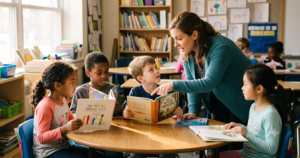
Picture Rohan again, this time in a small group doing a “say one thing” round. The rule is simple: after each chunk of the story, every student offers one thing they learned, a question they have, or a connection they made. First time around, Sam gives you the flat version: “It’s about a dog.” But the structure won’t let him off the hook, because everyone takes a turn at every stop. By the third stop, something shifts. He offers a prediction nobody asked for: “I bet the dog’s gonna get lost, ’cause they left the gate open.”
There it is. The exact thinking he throws out freely at story time, now happening on a text he is reading himself, because the activity built a place for it.
And here’s the reassuring part: you’re probably already doing the grown-up version of this. When you read aloud and wonder out loud about a character, you’re modeling that thinking. The activities just hand it to the students. You’re not starting over.
The Menu: Four Activities and When to Reach for Each
Think of these as tools on a pegboard, not a sequence to march through. Pick the one that fits today’s text and what you’re trying to find out or fix.
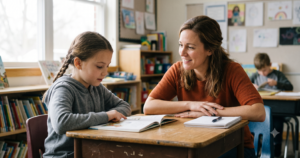
Structured partner talk (turn-and-talk). What I love about turn-and-talk is that it gets every kid talking about the text, and talking to each other, not just the two fastest hands. As an Academic Coach, the turn-and-talks I watched actually work weren’t the ones where a teacher just said “turn and talk to your partner.”
They were built on a routine the kids knew cold: face your partner, knee to knee, a sentence frame on the board for anyone who needed a way in, and the quiet expectation that you might be asked to share what your partner said, not your own idea. That last move changed the room. A child couldn’t wait out the thirty seconds; they had to listen. Reach for it when you want every voice thinking, not only the quickest responders.
Retell or summarize. A short oral or written retell, with a focus you name ahead of time (“tell me what mattered in this part and why”), is the fastest way to find out whether meaning got built or whether the words just went by. Reach for it when you need to check understanding, not coverage.
Prediction and question-generation. Asking students to predict what’s coming, or to generate their own questions as they read, keeps attention switched on during reading instead of after it’s too late. Palincsar and Brown’s reciprocal teaching research found that teaching students to ask their own questions while reading produces real comprehension gains, because it keeps the reader doing something with the text. Reach for it when attention is sliding and students are reading on autopilot.
Graphic organizers. Organizers are their own toolkit: a story map, a problem-and-solution frame, a sequence chart. They’re the right call when a student needs a visual place to hold the structure their memory keeps dropping. I won’t unpack them here, because they earn a post of their own. Reading comprehension graphic organizers walks through which organizer fits which kind of text. Reach for it when a reader can talk about pieces of a text but loses the shape of the whole.
Every one of these works the same way: it makes the invisible thinking of an active reader visible and required, which is how a passive reader becomes an active one. If you want the research on how comprehension develops underneath all of this, what is reading comprehension covers it fully.
What You’ll Notice When It’s Working
You’ll start to hear thinking you used to have to pull out of kids. A child who gave you “it was about a dog” last month will volunteer a prediction this month, unprompted, the way Sam did at his third stop. That’s the tell.
Watch your quieter readers, too. When the routine guarantees everyone takes a turn, and especially when students know they might have to report what a partner said, the kids who used to disappear behind the fast responders have a way in and a reason to use it. You’ll notice them listening, not just waiting for their turn to be over.
And you’ll get information you didn’t have before. The student who can’t offer a single thing at a stop, or whose retell is all surface and no meaning, is telling you something a fluency check never could. Some of your strugglers, like Rohan, aren’t struggling with comprehension at all. They have the thinking. They’ve just never been asked to do it with a book in their own hands.