Scarborough’s Reading Rope: What Every Teacher Needs to Know

Marcus reads the page about the dog and the pond with easy confidence. His voice has rhythm. His expression is natural. If you were listening from across the room, you would hear a reader.

But Marcus is not reading. He is predicting. His strong vocabulary and background knowledge let him guess which words should come next — and his guesses are so plausible that they sound like reading. Where the text says “raced,” Marcus says “ran.” Where it says “swiftly,” he says “quickly.” Every substitution makes perfect sense. None of them are the actual words on the page.

I sit beside him after the group and write “raced” on an index card — no picture, no surrounding sentence. He works through it letter by letter. It takes eight seconds. For a word he appeared to read fluently four minutes ago.

After years as a reading interventionist working with students exactly like Marcus, I can tell you what was happening. Marcus was not using both sides of the reading process — he was leaning entirely on one side to avoid the other. His language comprehension was so strong that it masked the fact that his word recognition was barely functioning. He did not sound like a reader because he was reading well. He sounded like a reader because he was compensating well.

When I finally encountered Scarborough’s Reading Rope, it gave me the framework to name what I had been watching for years. It showed me exactly why Marcus could sound convincing in context and fall apart in isolation — and more importantly, it showed me where to look when I wanted to figure out what a struggling reader actually needed.

That is what the Reading Rope does. Not just for Marcus — for every student who is struggling in ways you can see but cannot yet name.

What Is Scarborough’s Reading Rope?

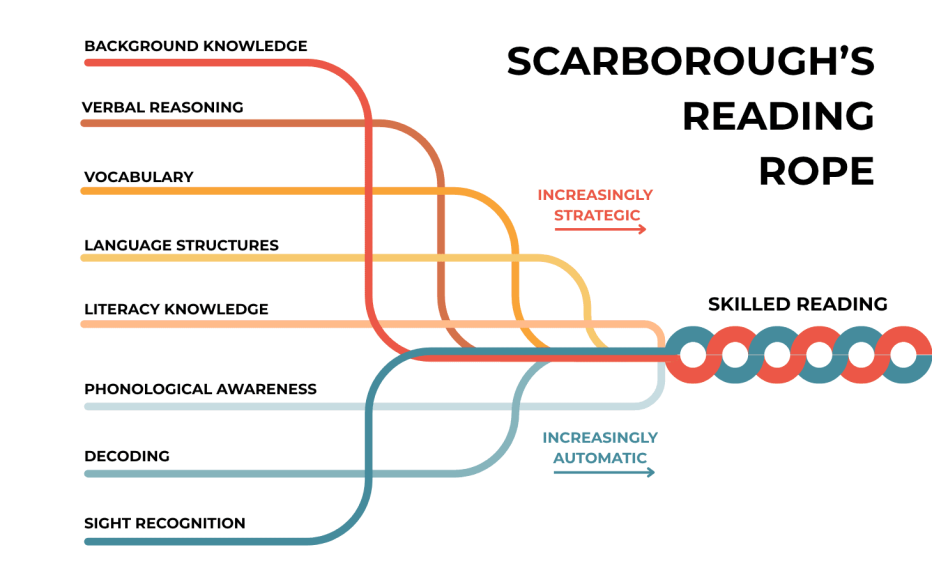
Scarborough’s Reading Rope is a visual model showing how eight distinct skills weave together to produce skilled reading. Created by literacy researcher Dr. Hollis Scarborough, it illustrates that reading is not one skill but many — and that those skills must develop together, not in sequence.

The model was born in a surprisingly practical way. In the early 1990s, Scarborough was giving presentations to parents about why learning to read is so complex. She twisted pipe cleaners together to show how different skills intertwine — and the metaphor stuck. The image was published in 2001 in the Handbook for Research in Early Literacy, and it has since become one of the most widely referenced frameworks in the science of reading.

Here is the core idea: skilled reading is like a tightly woven rope. The rope has two main bundles — language comprehension and word recognition — each made up of individual strands. When every strand is strong and woven tightly together, you get fluent reading with real understanding. When even one strand is weak, the whole rope is compromised.

What makes this model so useful for classroom teachers is that it does not just tell you that a student is struggling. It helps you see where — which strand, which bundle, which specific gap.

Scarborough's Reading Rope

Why the Reading Rope Matters for Your Students

The Reading Rope matters because it reveals something most of us were never taught: reading is not a single skill that develops on a smooth trajectory. It is a collection of skills that interact and depend on each other from the very beginning.

A student with strong vocabulary and rich background knowledge can look like a solid reader — even when her decoding is falling apart underneath. A student who can sound out every word on the page can still understand almost nothing if his language comprehension strands are weak. The rope explains why two students can look so different even though both are struggling — they are fraying in different places.

This is exactly the insight that was missing from most of our training. Many of us were taught to focus heavily on certain strands — building background knowledge, expanding vocabulary, fostering a love of books — while the word recognition strands were expected to develop on their own through exposure to text. The Reading Rope makes it impossible to hold that assumption. You can see, right there in the visual, that both bundles matter equally.

Research consistently confirms what the rope illustrates: students need both strong word recognition and strong language comprehension to become skilled readers. When 60% of my intervention students made progress by spring and then came back to my groups the following fall, the rope helped me understand why — we had been strengthening some strands without addressing the ones that were actually fraying.

What the Reading Rope Looks Like in a Real Classroom

If you spend a morning in a classroom watching students read, the Reading Rope is visible everywhere — once you know how to look.

The student who reads aloud beautifully during guided reading but cannot tell you what happened in the passage? That is Nadia — a second grader whose word recognition strands are solid. She decoded “environment” and “temperature” without a single error. But when I asked her to tell me what she just read, she looked at me like I had asked the question in another language. Her language comprehension strands — background knowledge, vocabulary, verbal reasoning — had not kept pace with her decoding. The words were getting off the page. Meaning was not arriving with them.

Then there is Marcus — the student from the opening of this post — who can have a sophisticated conversation about a topic but cannot read the words on the page about it. His language comprehension is strong, but his word recognition strands are not keeping up. He understands ideas. He cannot access them through print.

The student who reads accurately but so slowly that she is exhausted by the end of a page? Her decoding strand may be present but not yet automatic. Every word still costs conscious effort, leaving nothing for comprehension.

When the rope is working, you see a student who reads with accuracy, appropriate speed, natural expression, and genuine understanding — all at the same time. Not because she has one powerful skill, but because many skills are working together so smoothly that none of them is visible.

The Eight Strands of Scarborough’s Reading Rope

The Reading Rope contains eight strands organized into two bundles. Understanding what each one does — in plain classroom terms — is what turns the rope from a poster on your wall into a diagnostic tool you actually use.

Language Comprehension (Upper Strands)

These five strands represent what a reader brings to the text beyond the ability to decode words. As students develop, these strands become increasingly strategic — more purposeful, more intentional, more connected to each other.

Strand What It Means in Your Classroom
Background Knowledge What students already know about the world — the facts, concepts, and experiences they bring to a text. The student who understands a passage about volcanoes because she studied them in science has this strand working.
Vocabulary Not just knowing word definitions, but knowing words deeply — their shades of meaning, their connections to other words, how they behave in different contexts. A student with a rich vocabulary reads with less effort because fewer words stop her.
Language Structures Understanding how sentences are built — syntax and grammar patterns that signal meaning. A student who loses the thread in long, complex sentences may have a gap here.
Verbal Reasoning The ability to make inferences, understand figurative language, and draw conclusions that are not stated directly. This is what lets a reader understand that “my home is my castle” is not about an actual castle.
Literacy Knowledge Understanding how print works — genres, text features, the difference between fiction and nonfiction, how a table of contents relates to a book. This strand develops through exposure to many kinds of texts over time.

Word Recognition (Lower Strands)

These three strands represent how a reader gets words off the page. As students develop, these strands become increasingly automatic — faster, more accurate, requiring less and less conscious effort.

Strand What It Means in Your Classroom
Phonological Awareness The ability to hear and manipulate sounds in spoken language — syllables, rhymes, and individual phonemes. This is an oral skill, no print involved, and it is the foundation that decoding is built on.
Decoding Using knowledge of letter-sound relationships and spelling patterns to translate print into speech. This is the alphabetic principle in action — the understanding that letters represent sounds in a systematic, predictable way.
Sight Recognition The ability to recognize familiar words instantly, without sounding them out. This is not the same as memorizing a list of “sight words.” It is what happens when a word has been decoded successfully enough times that the brain stores it for automatic retrieval.

One thing Scarborough was clear about is that these strands do not develop independently. Growth in one strand often fuels growth in others. Improving decoding helps students encounter more words in print, which builds vocabulary. Building background knowledge introduces new words, which strengthens the vocabulary strand. The strands interact from the very beginning, which is why the rope shows them interweaving, not running parallel.

What Happens When a Strand Is Weak

Scarborough described this as the rope “fraying.” When one or more strands are weak, the entire rope loses strength — even if the other strands are solid.

This is the insight that changed how I look at every struggling reader. A single severely frayed strand can disrupt the whole process. And multiple mildly frayed strands — each one “not that bad” on its own — can combine to create significant difficulty.

Here is what makes this tricky in practice: a strong bundle can mask a weak one for a surprisingly long time. Marcus is the perfect example. His language comprehension was so strong that he could predict his way through texts convincingly enough to pass every guided reading check for years — without anyone noticing that his word recognition was barely functioning. The compensation held until the texts got complex enough that prediction alone could not carry him. The reverse happens too — a student with strong decoding but weak language comprehension can read every word on the page and understand almost nothing.

This is also why the two developmental shifts Scarborough described matter so much. As students grow, the language comprehension strands should become increasingly strategic — more purposeful, more deliberate — while the word recognition strands should become increasingly automatic. When word recognition never reaches automaticity, the student must spend so much cognitive effort on the words themselves that nothing is left for making meaning. That is the fraying you can hear when a student reads a paragraph accurately and then cannot tell you what it said.

Common Questions About the Reading Rope

Is fluency a separate strand of the rope?

No — and this is one of the most common misunderstandings. Scarborough intentionally left fluency out as a separate strand because she viewed it as an indicator of overall reading skill, not a standalone component. When all the strands are strong and working together, fluency is the natural result. It is a useful way to estimate overall reading proficiency, but it is not a separate skill to teach in isolation.

Do you teach the bottom strands first and the top strands later?

No. This is perhaps the most important point of the entire model. The strands develop concurrently, not sequentially. Word recognition and language comprehension need attention from the very beginning — kindergarten students need phonological awareness instruction and vocabulary building and background knowledge and exposure to language structures, all at the same time. The rope is not a ladder you climb. It is a rope you weave.

Does the Reading Rope tell me what curriculum to use?

Not directly. The rope is a framework for understanding what skilled reading requires — not a program or a scope and sequence. But it gives you a lens for evaluating whether your instruction is addressing all the strands or leaving some unattended.

What This Means for Your Teaching

If you have read this far, you now understand something that took me years to piece together: reading is not one skill, and a student who struggles is not struggling with “reading” as a single, undifferentiated thing. She is struggling with specific strands — and until you figure out which ones, you are guessing at solutions.

Here is one thing you can do this week. Pick a student you have been worried about. Instead of asking “why can’t she read?” ask: “Which strands are strong and which ones are fraying?” Listen to her read aloud — is the word recognition automatic, or is every word effortful? Ask her to retell — does she have the vocabulary and background knowledge to make sense of it? That single shift, from “she’s struggling” to “she’s struggling here,” is the beginning of instruction that actually addresses what is going on.

Understanding the rope is a powerful first step. But there is a real gap between understanding what the strands are and knowing how to assess each one, teach each one explicitly, and adjust when a student is not progressing. The rope gives you the map. The training gives you the tools. If you are ready to go deeper, the posts on reading rope explained and reading rope model are good next steps.

Key Takeaways

  • Scarborough’s Reading Rope shows that skilled reading requires eight distinct skills — five in language comprehension and three in word recognition — woven together, not developed in sequence.
  • A student can appear to be reading well when one bundle is strong enough to compensate for weakness in the other, which is why some struggling readers go unnoticed for years.
  • When even one strand is weak, the entire rope is compromised — identifying which strand is fraying changes your instruction from guessing to targeting.
  • The strands develop interactively from the beginning, which means effective reading instruction addresses both word recognition and language comprehension at every grade level.
  • The rope is a diagnostic lens, not a curriculum — but it will show you whether your instruction is building all the strands or leaving some unattended.

All student names and identifying details in this post are fictional composites drawn from real classroom observations across 20+ years of teaching and coaching. No profile represents a single identifiable child.

Hello!

My Mission is Simple

Give teachers the science-backed tools they need to help every student become a confident reader.
I’m so glad you’re here! 

Give me the Quiz!

Feeling Stuck?

Understanding Scarborough’s Reading Rope changes the way you see your struggling readers — but seeing the problem clearly is not the same as addressing it.

Right now, you can start here: I put together a free guide called 5 Silent Signs Your Students Are Struggling to Read. It will help you spot the students whose rope is fraying — the ones who are compensating, avoiding, or shutting down in ways that are easy to miss.

Additional Resources

The concepts in this post draw on Hollis Scarborough’s original presentation “The Reading Rope: Key Ideas Behind the Metaphor,” published through The Reading League’s COMPASS resource. If you want to go deeper into the research behind the model, this is the primary source I’d point you toward.

If you’re like me and love to keep learning, this is another resource that have earned its keep on my crowded bookshelf:

As an Amazon Associate, I earn from qualifying purchases.

reading rope activities
Science of Reading

Reading Rope Activities: What It Actually Looks Like to Strengthen Every Strand

Nadia read every word correctly. “Environment.” “Temperature.” “Precipitation.” She sounded them out carefully, accurately, at a pace that wouldn’t raise any flags.

Then I asked her to tell me what she’d just read.

She looked at me with an expression I’ve come to recognize — not confused, exactly. More like someone who has been asked a question in a language she almost speaks. “It was about… animals? And where they live?”

Read More »
strands of the reading rope
Science of Reading

What Are the 8 Strands of the Reading Rope? (And Why Every Teacher Should Know Them)

Isaac scored 100% on the baseball passage and 20% on the American Revolution.

Same test. Same morning. Same third grader reading aloud with solid accuracy on both passages — the Lexile levels were within fifty points of each other. When I pulled the passage-level data, I sat there staring at it, because his average looked like a student who was “just below benchmark.” The average told me almost nothing. The strand-by-strand breakdown told me everything.

Read More »

Grab your free lesson plan!

You're Just a Click Away!