What Is Guided Reading — and Why Isn’t It Working for Every Student?

Marcus reads beautifully in his third-grade guided reading group. He reads with expression. He retells the story. His running record shows 96% accuracy. His teacher has no concerns.

Then, later, you hand him a single word from that same passage — on its own, no picture, no sentence around it — and he can’t read it. The word he “read” in the group was never actually read. It was predicted from the picture, the first letter, and the shape of the sentence, and the guided reading lesson around it had no way of catching what was missing.

If you’ve ever had a student who sounds like a reader in small groups but falls apart on grade-level assessments, you’ve met Marcus. After years as a reading interventionist working with struggling readers in grades K–5, I can tell you he isn’t unusual; he’s one of the most common patterns I’ve seen, and the one most likely to go undetected. Understanding what guided reading is, and what it assumes, is the first step toward understanding why.

So What Is Guided Reading, Exactly?

Guided reading is a small-group approach where a teacher works with four to six students at a similar level, using leveled texts and prompting them to problem-solve words through context, meaning, and first-letter cues. It matters because that prompting trains students in the strategies reading science links to struggling readers, not skilled ones, so a child can look successful in the group while missing the decoding skills the assessment never checks.

The model was developed by Irene Fountas and Gay Su Pinnell in their book Guided Reading: Good First Teaching for All Children in 1996, and it became the instructional centerpiece of balanced literacy classrooms across the country. If you were trained in balanced literacy, and most of us were, you probably learned to run guided reading groups in your first year, and you probably still run them.

Its built-in assessment tool is the running record, which tracks accuracy, self-corrections, and use of the MSV cueing system: Meaning, Structure, and Visual information. The whole approach rests on one assumption, that children learn to read primarily by reading, and that with the right text and the right prompting they’ll figure words out from context. I spent years inside that assumption. So did nearly every colleague I worked with.

Why the Assumptions Matter

Guided reading’s prompting system is built around strategies reading science identifies as compensatory. When a teacher says, “Does that look right? Does it make sense? Try the first sound and think about what would fit,” she is teaching the strategies of a reader who can’t decode. Not because she’s doing anything wrong. Because the model was designed that way, before the research was widely available.

I spent one summer transcribing every word in our leveled reader set, looking for the phonics sequence I was sure was underneath. It wasn’t there. Leveled texts are organized around language complexity, not phonics patterns. There was no decoding progression to find, and that discovery is what started my questions about the whole model.

What Does the Research Say About Guided Reading?

Guided reading as a complete approach has never been a strong performer in controlled research, for the same reason balanced literacy hasn’t: it was never defined tightly enough to test as a single method. What has been tested is the model underneath it, and the verdict there is clear.

The prediction-based view of reading traces to Kenneth Goodman’s 1967 “psycholinguistic guessing game,” the theory that became the MSV cueing system, and eye-movement research has since shown that skilled readers process the print on the page rather than guessing from context — context-guessing is what struggling readers fall back on when they can’t decode. The full evidence picture lives in the balanced literacy framework; the word-level research on three-cueing is covered in MSV reading.

The intervention evidence points the same direction. The federally funded i3 scale-up evaluation of Reading Recovery, the best-known balanced literacy intervention, found strong initial gains. But a 2022 follow-up study tracking the same students found those gains faded: students performed comparably to or worse than peers by third and fourth grade. Short-term performance, not durable reading ability. That is the pattern a guided-reading-only model tends to produce, because guided reading is supported practice, not instruction in the code.

What Guided Reading Can Miss

A student like Marcus has built his whole word-identification strategy around initial-letter-plus-context prediction. “Home” for “house.” “Fast” for “first.” “Ran” for “raced.” Every substitution preserves enough meaning that the running record codes it as a minor error, or misses it entirely. The result is a third grader who sounds like a reader while bypassing decoding almost completely. Here’s the part that’s hard to sit with: Marcus isn’t failing at guided reading. He’s succeeding at it.

Running records miss this because they were built on the same theory of reading that guided reading is. A record measures whether the word a child produces makes sense, fits the sentence, and starts with the right letter, so a child leaning on pictures and first-letter cues can score well in context and still be unable to read those words in isolation.

I noticed this pattern for the first time in my first year as a reading interventionist. We’d just gotten a full LLI library, brand new books, lots of them, and the training told us students would love the illustrations and the language would do the work. In the early levels, my kids seemed to be reading, but I wasn’t sure they were. They looked at the pictures more than the words. When the books got harder, with words like horse, cow, and sheep, they got stuck.

I asked the classroom teacher when her students would learn the phonics patterns that would help (or, ee, ow). She said, “We don’t touch those for a while. That’s why we teach them picture power, to use the pictures when they don’t know a word.” That was the first time I realized the strategies the program assumed my students would use were the same strategies the assessment was built around. The students weren’t compensating by accident. The whole system was teaching them to do it.

The Misconception That Keeps It in Place

The most common misunderstanding about guided reading is that it teaches children to read. It provides supported practice at a matched text level, and practice is valuable. But practice and instruction are different things. Instruction teaches a skill a student doesn’t yet have, explicitly and in a sequence that builds; practice applies a skill already taught. Guided reading is practice. Explicit, systematic phonics is instruction. When guided reading is the only vehicle, students who need explicit teaching of the code don’t receive it. The issue isn’t the format. It’s what’s missing underneath.

What This Means for Your Teaching

If you run guided reading groups, you don’t have to stop. The small-group structure isn’t the problem; what matters is what happens alongside it. Students need explicit, systematic phonics that teaches the alphabetic code directly, through clear instruction in how letters and sounds connect rather than through prompts and predictions. With that foundation in place, guided reading can do what it’s best at: letting students apply what they’ve learned in connected text with a teacher who is listening.

Understanding why guided reading misses some students and being equipped to deliver explicit systematic phonics instruction are different things, and you don’t have to figure out the second one to start noticing the first.

One thing you can try this week: pick a student who reads fluently in your guided reading group. Write five words from today’s text on index cards. Hand them over one at a time, without pictures or context. If the student reads them quickly and accurately, the decoding is solid. If there’s hesitation or guessing, you’ve found something the running record didn’t show you.

Key Takeaways

  • Guided reading is a small-group practice built on leveled texts, teacher prompting, and MSV analysis, the centerpiece of balanced literacy instruction.
  • The model assumes students learn to read by reading in context. Reading science shows skilled readers process nearly every letter, not by guessing from context.
  • Running records track accuracy in context but can miss students who compensate by predicting words from pictures and first letters.
  • Guided reading is practice, not instruction. When it’s the only vehicle, students who need explicit phonics teaching don’t receive it.


Student profiles in this post are fictional composites. Behavioral patterns, skill gaps, and classroom moments are grounded in real observations from classroom teaching and reading intervention work. No profile represents a single identifiable child.

Hello!

My Mission is Simple

Give teachers the science-backed tools they need to help every student become a confident reader.
I’m so glad you’re here! 

Where to Go From Here

Give me the Quiz!

I ran guided reading groups for years. I was good at them, kept careful running records, and was proud of the instruction happening in that corner of my classroom. The students who taught me something was missing were the ones who looked like readers in the group and struggled everywhere else. Learning the research didn’t mean everything I’d done before was wrong. It meant I could finally see what had been invisible.

If you want to know whether your students are genuinely decoding or quietly compensating, my free guide, 5 Silent Signs Your Students Are Struggling to Read, walks you through exactly what to look for.

Where This Research Comes From

Recommended Reading

Research Sources

As an Amazon Associate, I earn on qualifying purchases.

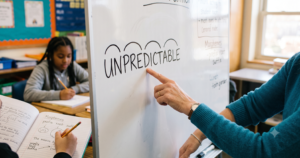
A boy reads aloud from "The Snowy Day" while a teacher records his progress on a running record during guided reading.
Balanced Literacy

Balanced Literacy: What It Is, Where It Came From, and What the Research Actually Says

Balanced literacy is an approach to reading instruction that combines several classroom practices (guided reading, shared reading, read-alouds, interactive writing, independent reading, and some word study) into a daily literacy block. It was designed to give students multiple entry points into reading through a balance of teacher-led and student-directed experiences, and it became the dominant approach in American elementary schools beginning in the late 1990s.

Read More »
A teacher's hand guides a student's finger across letter tiles spelling S-A-T and P-I-N on a wooden desk.
Science of Reading

How to Teach Orthographic Mapping: A Sequence That Sticks

Teaching orthographic mapping means sequencing and pacing instruction so that students bond sounds to spellings, one reliable correspondence at a time, until each word type becomes automatic. It matters because mapping isn’t something you deliver in a lesson. It’s something a student builds across many successful encounters, which makes your job less “cover the skill” and more “sequence the conditions for it to form.”

Read More »
A teacher holds up a sound box card reading /f/ /i/ /sh/ as students practice an orthographic mapping activity.
Science of Reading

Orthographic Mapping Activities: A 10-Minute Routine

Orthographic mapping activities are short, sound-first routines that help students bond a word’s sounds to its spelling so the word is stored for instant recognition. They matter because this bonding, not repetition, is what moves a word from effortful decoding into automatic sight, which is the difference between a reader who sounds out “the” every time and one who just reads it.

Read More »

Grab your free lesson plan!

You're Just a Click Away!