L is for Literacy
The Science of Reading Simplified

Enemy Pie: When One Summer’s Enemy Becomes Your Best Friend
Every teacher knows that moment when classroom dynamics shift—when friendships fracture, when someone new joins the group, or when playground conflicts spill into learning time. We watch students navigate these social challenges, sometimes successfully, sometimes not so much. Enemy Pie offers something remarkable: a story that doesn’t just acknowledge these inevitable childhood conflicts but provides a genuine roadmap for resolution. This isn’t your typical “just be nice” message—it’s a thoughtful exploration of how spending time with someone can completely transform our understanding of who they are.
Teachers consistently find that Enemy Pie creates those magical classroom moments where students make deep connections to their own experiences while learning profound lessons about empathy and friendship. The story’s gentle wisdom about how we sometimes create enemies in our minds resonates with children who’ve experienced playground conflicts, neighborhood tensions, or the challenge of welcoming someone new into their established friend groups.
A Recipe for Friendship That Actually Works
Enemy Pie tells the story of a young boy whose perfect summer gets derailed when Jeremy Ross moves in next door to his best friend Stanley. Jeremy strikes him out at baseball, has a trampoline party without inviting him, and somehow wins over Stanley’s friendship. The frustrated narrator adds Jeremy’s name to his brand-new enemy list—a list that hangs prominently in his tree house where Jeremy Ross is definitely not allowed.
When the boy complains to his dad about his Jeremy Ross problem, Dad suggests a time-tested solution: Enemy Pie. But there’s a catch—for the pie to work properly, our narrator must spend an entire day with his enemy, being as nice as possible. What follows is a day of unexpected fun, surprising discoveries, and the realization that enemies might just be friends we haven’t given a chance.
Derek Munson’s storytelling perfectly captures that childhood logic where problems seem enormous and solutions feel impossibly complex. The book works beautifully for grades K-5, with a read aloud time of approximately 15-20 minutes. Tara Calahan King’s expressive illustrations bring the emotional journey to life, from the narrator’s initial frustration to his growing confusion and eventual joy as the day unfolds.
Building Bridges Through Story Structure
Enemy Pie offers rich opportunities for developing essential literacy skills within a structured literacy framework. The story’s clear problem-solution structure provides an excellent foundation for teaching narrative elements and comprehension strategies. Students can easily identify the narrator’s problem (having an enemy), the proposed solution (Enemy Pie), and the surprising resolution (friendship).
The book introduces sophisticated vocabulary naturally within context—words like “neighborhood,” “trampoline,” “ingredients,” and “absolutely”—giving teachers perfect opportunities for explicit vocabulary instruction. These Tier 2 words appear frequently across various texts, making them valuable additions to students’ growing vocabularies.
The story’s emotional arc supports comprehension development as students practice inferencing skills. They must read between the lines to understand how the narrator’s feelings change throughout the day, moving from anger and suspicion to confusion and finally to genuine friendship. This character development provides excellent material for teaching students to track emotional changes and make predictions about character motivations.
Teachers find that Enemy Pie naturally supports discussions about point of view and perspective-taking—crucial comprehension skills that transfer across all reading experiences. The story demonstrates how the same person can seem completely different when viewed through the lens of friendship rather than animosity.
Setting the Stage for Success
Before opening Enemy Pie, spend a few minutes activating students’ background knowledge about friendship and conflict resolution. Ask students to think quietly about a time when they met someone new who seemed unfriendly at first, or when they had to spend time with someone they weren’t sure they liked.
Introduce key vocabulary that will enhance comprehension: “enemy” (someone you think you don’t like), “ingredients” (the things that go into making something), and “neighborhood” (the area where you live with houses close together). Consider discussing the concept of a “recipe” and how some recipes aren’t just for food—they can be for solving problems too.
Set a clear purpose for listening: “As we read, think about how the boy’s feelings about Jeremy change throughout the story. What causes those feelings to shift?” This focus helps students attend to the story’s emotional development while practicing the crucial skill of tracking character change over time.
Strategic Read Aloud Moments
Begin reading with enthusiasm for the opening line: “It should have been a perfect summer.” Pause here to let students share what their perfect summer might include, then continue with “But it wasn’t” to create that dramatic tension that hooks young listeners.
When you reach the enemy list scene, pause to discuss: “Has anyone ever felt so frustrated with someone that you wanted to make a list like this?” This validates students’ experiences while building connection to the text.
At the moment when Dad suggests Enemy Pie, pause and ask: “What do you think might be in a pie that helps with enemies?” Students love making predictions here, and their creative suggestions often lead to rich discussions about problem-solving approaches.
The most powerful stopping point comes when the boy realizes he’s actually having fun with Jeremy. Pause here and ask: “What’s happening to his feelings about Jeremy? Why do you think this is changing?” This moment beautifully demonstrates how spending time together can shift our perceptions of others.
Extending the Learning
After reading Enemy Pie, engage students in discussing how the boy’s opinion of Jeremy changed throughout the day. Ask: “What ingredients do you think were really in the Enemy Pie? What made it work?” Guide students to understand that the real “ingredients” were time spent together, kindness, and being open to seeing someone differently.
Create a class recipe for friendship, asking students to contribute “ingredients” based on what they learned from the story. This activity reinforces the book’s message while giving students ownership of the friendship concepts.
For writing connections, invite students to write about a time they changed their mind about someone, or to create their own “recipe” for solving a problem they’re facing. This personal reflection deepens comprehension while practicing narrative writing skills.
The story naturally connects to social studies discussions about community and getting along with neighbors, as well as social-emotional learning conversations about empathy, perspective-taking, and conflict resolution.
Teacher Talk: How to Get the Most Out of “Enemy Pie”
This book works exceptionally well for addressing classroom conflicts that inevitably arise, especially at the beginning of the school year when students are still learning to navigate relationships. Many teachers find it helpful to return to Enemy Pie throughout the year whenever friendship challenges emerge.
The story’s message about spending time together to understand someone better translates beautifully into practical classroom applications. Consider using the book to introduce partner work or when assigning new seating arrangements—the idea that working together helps us see people differently resonates with students of all ages.
Be prepared for rich discussions about fairness and first impressions. Students often want to debate whether Jeremy was really mean or if the narrator was being unfair. These conversations provide excellent opportunities for developing critical thinking skills while reinforcing the story’s themes.
The Science Behind Perspective-Taking
Enemy Pie aligns beautifully with research on social-emotional learning and comprehension development. The story provides authentic practice with perspective-taking—a crucial skill for both reading comprehension and social success. When students understand how the narrator’s perspective shifts, they’re developing the same cognitive flexibility that helps them understand complex characters in future texts.
The book’s problem-solution structure supports comprehension skill development within the broader framework of narrative understanding. Students who can identify and track the emotional problem-solving process in Enemy Pie are building foundations for understanding character motivation and plot development across increasingly complex texts.
The vocabulary development opportunities in this book align with systematic approaches to building academic language. The context-rich presentation of sophisticated words provides the kind of meaningful exposure that supports long-term vocabulary growth.
Creating Community Through Story
What makes Enemy Pie particularly valuable is how it addresses one of childhood’s most common challenges while providing a hopeful, actionable solution. The story doesn’t minimize the narrator’s feelings about Jeremy—it validates them while showing how those feelings can change through experience and openness.
In our structured literacy classrooms, we know that rich literature like Enemy Pie provides the background knowledge and emotional intelligence that enhance all reading experiences. This story doesn’t just teach about friendship—it builds the kind of social awareness and empathy that help students connect more deeply with characters across every text they’ll encounter.
The magic of Enemy Pie lies in its gentle reminder that the people we think we don’t like might surprise us if we give them a chance. In a world where children often feel pressured to make quick judgments, this story offers the gift of second chances and the wisdom that understanding someone better starts with spending time together.

Written by Derek Munson
Illustrated by Tara King
Grade Level
K – 3rd
Time to Read
15 – 20 minutes
Core Skills
Character development, problem-solution structure, vocabulary in context, perspective-taking
Key Vocabulary
enemy
someone you think you don’t like or who seems unfriendly
ingredients
the things that go into making something
neighborhood
the area where you live with houses close together
absolutely
completely or totally
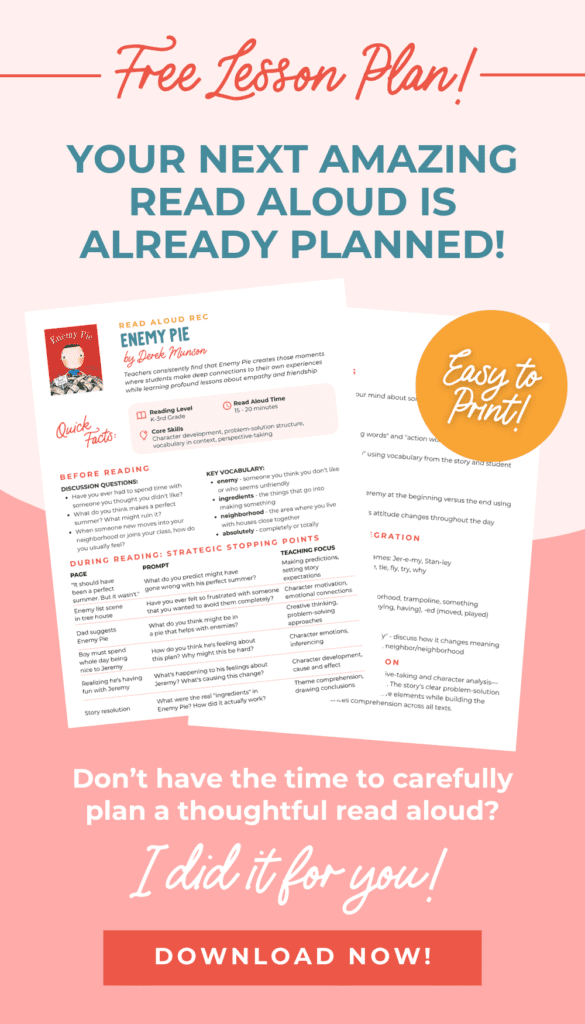
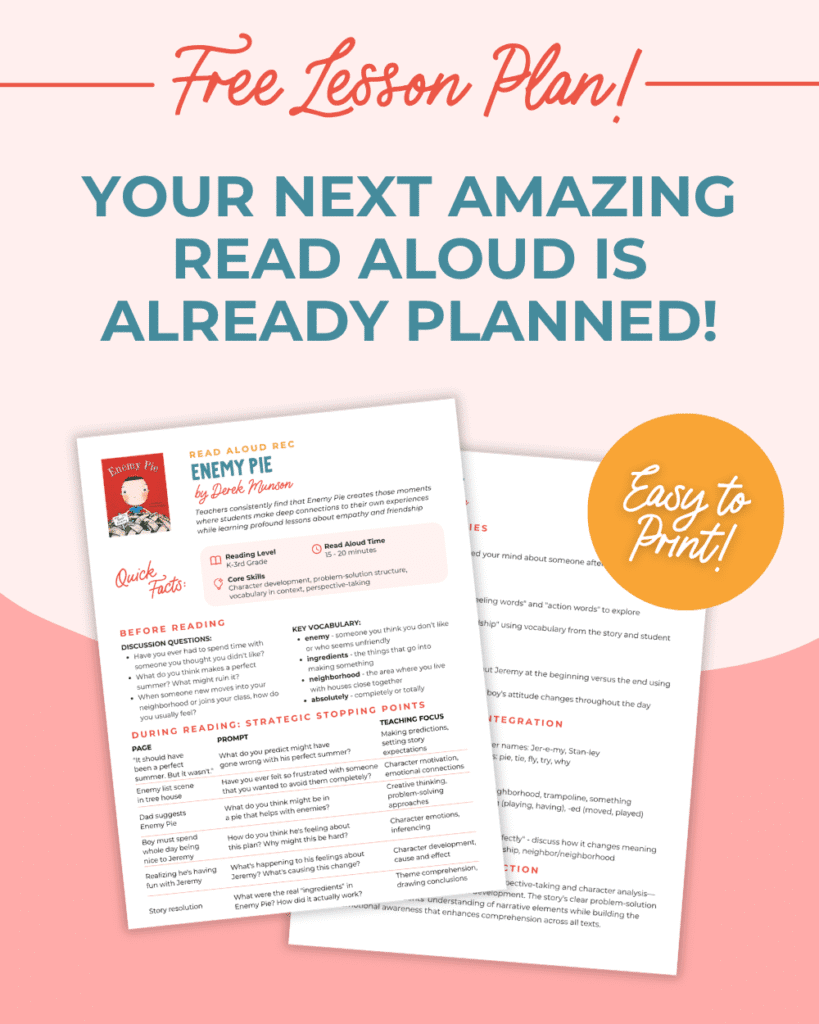
Wish You Could Download This Post As a Beautifully Formatted Lesson Plan?
You Can!!
I know that as much as you want to, you don’t always have time to carefully plan a thoughtful read aloud. That’s why I did the hard work for you! Everything you need is in this downloadable Read Aloud Lesson Plan for “Enemy Pie” All of the vocabulary notes, pre-reading questions, strategic stopping points, and ways to extend the learning beyond the story are ready to go, just for you!
Download the free guide and you’ll have everything you need at your fingertips!