L is for Literacy
The Science of Reading Simplified

The Girl Who Never Made Mistakes Read-Aloud Lesson Plan
You know that student in your class—the one who freezes during writing workshop because they’re terrified of misspelling a word? The child who erases their math work three times before raising their hand? The kindergartner who won’t join morning circle time because they might mess up the hand motions?
Perfectionism shows up early in elementary classrooms, and it’s heartbreaking to watch. These are often our brightest, most capable students, yet they’re paralyzed by the fear of making mistakes.
They need stories that show them what we tell them every day: mistakes aren’t failures—they’re how we learn, grow, and sometimes discover the best parts of ourselves.
That’s exactly what makes The Girl Who Never Made Mistakes such a powerful classroom tool. This isn’t just a charming story about a perfectionist child—it’s a thoughtfully crafted narrative that helps students understand that mistakes can lead to joy, laughter, and unexpected freedom.
When you pair this engaging picture book with systematic read-aloud instruction, you’re building both comprehension skills and the emotional resilience students need to become confident learners.
Why This Book Works for Structured Literacy
Teachers implementing Science of Reading practices sometimes wonder where read-alouds fit in their daily schedule. Here’s the truth: while systematic phonics instruction teaches students how to read, read-alouds teach them how to comprehend.
The Girl Who Never Made Mistakes delivers essential language comprehension instruction that students need while they’re still developing decoding skills.
Vocabulary in Meaningful Contexts
The Girl Who Never Made Mistakes introduces vocabulary that’s both sophisticated and accessible. Words like “auditorium,” “stunning,” and “wobbled” appear naturally within the story context, giving students multiple exposures to academic language.
The book’s description of Beatrice’s daily routines—matching socks, measuring ingredients precisely, greeting fans politely—provides rich context that helps students understand what perfectionism actually looks like. These aren’t vocabulary words isolated on flashcards; they’re terms students encounter while emotionally invested in Beatrice’s journey.
Inferencing and Reading Between the Lines
The Girl Who Never Made Mistakes is beautifully constructed for teaching inference skills. The text never directly states that Beatrice is anxious or stressed about her reputation—instead, students must infer her emotional state from details like her nervous stomach before the talent show and her reluctance to join her friends ice skating.
The illustrations reveal what the text doesn’t say: Beatrice’s tense expressions, the crowd’s high expectations, her brother Carl’s carefree joy. Teaching students to notice these details and draw conclusions builds the inferencing skills that skilled readers use automatically.
Background Knowledge About Performance Pressure
The Girl Who Never Made Mistakes builds students’ understanding of performance anxiety, peer pressure, and the weight of expectations—concepts they’ll encounter repeatedly in literature and life. The story’s talent show setting provides concrete context for discussing how it feels when everyone is watching and expecting perfection.
This schema supports students’ comprehension of future texts involving characters facing similar pressures, while also validating their own experiences with performance situations.
Before Reading
Discussion Questions:
- Have you ever felt nervous about making a mistake in front of other people—like during a class presentation, a soccer game, or performing in a show?
- Do you know someone who seems to do everything perfectly, never messing up? What do you think that feels like for them?
- What’s something you tried that didn’t work out the way you planned? What happened next?
Key Vocabulary:
- mistake – an error or something done wrong
- nervous – feeling worried or anxious about something
- perfect – without any errors or flaws
- reputation – what people think and say about you
During Reading – Strategic Stopping Points
| PAGE/MOMENT | PROMPT | TEACHING FOCUS |
| After Beatrice wakes up and gets ready perfectly | Why do you think Beatrice is so careful about everything she does—matching her socks exactly, measuring the peanut butter and jelly the same? | Character motivation and interpreting behavior |
| When fans greet Beatrice outside her house | What do you notice about how other people treat Beatrice? How might that make her feel? | Inferencing emotional responses from context |
| When Beatrice watches her friends skating but says “No, thanks” | Why do you think Beatrice doesn’t want to join her friends, even though they look like they’re having fun? | Connecting character decisions to personality traits |
| When Beatrice’s legs slip out from under her and the eggs go flying | What do you predict will happen next? Will Beatrice catch the eggs or not? | Making predictions based on story structure |
| After Humbert sneezes and the balloon explodes on stage | How do you think Beatrice feels in this moment? What would you do if this happened to you? | Perspective-taking and emotional response |
| When Beatrice starts laughing instead of crying | Why is this moment such a big change for Beatrice? What’s different now? | Analyzing character transformation and theme |
| When Beatrice puts on mismatched socks the next morning | What does choosing different socks tell us about how Beatrice has changed? | Interpreting symbolic actions and drawing conclusions |
Making This Lesson Work in Your Real Classroom
Timing & Scheduling Tips
The Girl Who Never Made Mistakes works beautifully as a 20-minute interactive read-aloud session. This book is particularly powerful at the beginning of the school year when you’re establishing classroom culture around risk-taking and growth mindset.
It’s also perfect during test preparation season when students need reminders about managing performance anxiety, or before any classroom performance situation like presentations or talent shows.
Classroom Management Strategies
For this emotionally resonant book, use a structured turn-and-talk protocol at strategic stopping points. After asking discussion questions, say “Turn to your partner and share a time when you felt nervous about making a mistake in front of others.”
Give students 30 seconds of think time before they turn, provide a sentence frame like “I felt nervous when…” for students who need language support, then call on 2-3 partnerships to share with the whole group. This structure ensures every student processes the theme personally while maintaining engagement.
Differentiation That Actually Works
For Emerging Readers & English Language Learners:
Pre-teach the key vocabulary with visual supports—show actual images of an auditorium, demonstrate wobbling by walking unsteadily, use facial expressions to show what “stunning” means. Provide sentence frames for discussion: “Beatrice felt _____ when people were watching her” or “Making a mistake can be _____ because _____.”
For Advanced Readers & Thinkers:
Challenge students to consider the deeper implications of Beatrice’s transformation: “How might Beatrice’s mistake actually help her friends who were afraid to try new things?” or “What do you think Beatrice might do differently at next year’s talent show?”
Extend the discussion by connecting to growth mindset research: “Scientists have discovered that making mistakes actually helps our brains grow stronger. How does Beatrice’s story show this?”
Extension Activities
Writing Connection
Have students write a personal narrative about a time they made a mistake that turned out okay or even taught them something valuable. Younger students can draw pictures and dictate their stories, while older students write full paragraphs.
Provide a story structure frame: “First I tried to… Then something went wrong when… I felt… But then… Now I know…”
Vocabulary Development
Create a “Mistake Hall of Fame” word wall where students add vocabulary words that describe different ways people respond to mistakes: embarrassed, frustrated, worried, relieved, amused, resilient. Throughout the week, students find these words in other texts or use them to describe characters’ reactions, reinforcing the vocabulary in multiple meaningful contexts.
Comprehension Builder
Use a two-column chart labeled “Before the Mistake” and “After the Mistake” to help students analyze how Beatrice’s character transforms. In the left column, students record what Beatrice did and how she acted when she was trying to be perfect—her careful routines, avoiding ice skating, feeling nervous.
In the right column, they note changes after the talent show—mismatched socks, trying ice skating, laughing when she falls. This visual comparison helps students understand character development and theme.
How This Connects to the Bigger Picture of Reading Instruction
Teachers transitioning to Science of Reading approaches sometimes worry that systematic phonics instruction means less time for the rich literature discussions they love. The Girl Who Never Made Mistakes demonstrates why both components are essential for reading success.
Oral Language Foundations
Young students’ listening comprehension develops years before their reading comprehension catches up. A kindergartner who can barely decode CVC words can still discuss complex themes like performance anxiety, peer pressure, and personal transformation when those concepts are presented through an engaging read-aloud.
This lesson builds sophisticated comprehension skills—making inferences, analyzing character motivation, identifying theme—while students are still developing the decoding abilities they need to access these concepts independently. The oral language practice with academic vocabulary and complex sentence structures provides the comprehension foundation students will apply when they can read chapter books on their own.
Background Knowledge That Powers Future Reading
Every read-aloud builds world knowledge that supports comprehension across texts and subjects. The Girl Who Never Made Mistakes teaches students about talent shows, juggling, performance preparation, and the social dynamics of being known for something specific.
This knowledge creates mental schemas that help students understand future stories involving similar situations. When they encounter characters dealing with performance pressure in other books, students can connect back to Beatrice’s experience.
This accumulated knowledge becomes the “comprehension currency” that skilled readers draw on automatically to understand new texts efficiently.
The key is being purposeful about which books you choose and how you teach them—selecting texts that build essential knowledge and vocabulary while using systematic instructional approaches that develop specific comprehension skills.
Structured Literacy Integration
Phonological Awareness
Use character names and key vocabulary from The Girl Who Never Made Mistakes for syllable segmentation practice. Have students clap the syllables in “Bea-trice Bot-tom-well” (5 syllables), “tal-ent show” (3 syllables), and “au-di-to-ri-um” (5 syllables).
For younger students, contrast one-syllable words from the story like “fans,” “egg,” and “stage” with multisyllabic words, helping them hear the difference in word length. This connects phonological awareness practice directly to the story’s content rather than using random word lists.
Morphology Extension
Analyze the word “mistakes” by breaking it into meaningful parts: the base word “mistake” plus the plural suffix “-s.” Extend this to other words from the story: “wobbled” contains “wobble” + past tense “-ed,” “stunned” includes “stun” + “-ned” (with consonant doubling), and “carefully” breaks into “care” + “-ful” + “-ly.”
Understanding how words are built from meaningful parts helps students both decode unfamiliar words and understand their meanings more precisely.
The Science of Reading Connection
The Girl Who Never Made Mistakes exemplifies how read-alouds deliver essential language comprehension instruction within a Science of Reading framework. This lesson systematically builds vocabulary (auditorium, stunning, wobbled), develops inferencing skills through strategic questioning, and constructs background knowledge about performance situations and emotional resilience.
The structured stopping points, discussion protocols, and extension activities integrate multiple literacy components—vocabulary, comprehension strategies, and oral language development—simultaneously.
This approach honors the research showing that skilled reading requires both word recognition and language comprehension working together. While your systematic phonics instruction teaches students to decode “auditorium,” this read-aloud lesson ensures they understand what an auditorium is, how it functions in this story, and how that knowledge connects to their own experiences.
That’s comprehensive literacy instruction that supports reading development from multiple angles.
Why The Girl Who Never Made Mistakes Deserves a Place on Your Bookshelf
This is the book students remember years later when they’re standing at a spelling bee, trying out for a sports team, or facing their first middle school presentation. The Girl Who Never Made Mistakes captures something essential about childhood—that moment when you realize perfection isn’t just impossible, it’s actually keeping you from the best parts of life.
Students absolutely love the talent show disaster scene. The buildup of tension as Beatrice prepares her juggling act, the audience’s high expectations, Humbert’s unexpected sneeze, and the spectacular explosion of water balloon and pepper create a moment of pure dramatic payoff that kids find hilarious.
But what makes them return to this book again and again is Beatrice’s laugh—that genuine, uncontrollable belly laugh that shows she’s finally free from the impossible standards she’d been carrying. Students see themselves in that moment, whether they’re the perfectionists who need permission to mess up or the carefree kids who want their careful friends to relax and have fun.
The story also sparks important conversations about peer pressure and identity beyond academics. When your students discuss why Beatrice said no to ice skating or analyze how the crowd’s expectations affected her choices, they’re processing their own experiences with being known for something specific—the “smart kid,” the “fast runner,” the “good reader.”
Those discussions can shift classroom culture in powerful ways.
Which of your students needs to hear Beatrice’s story right now?
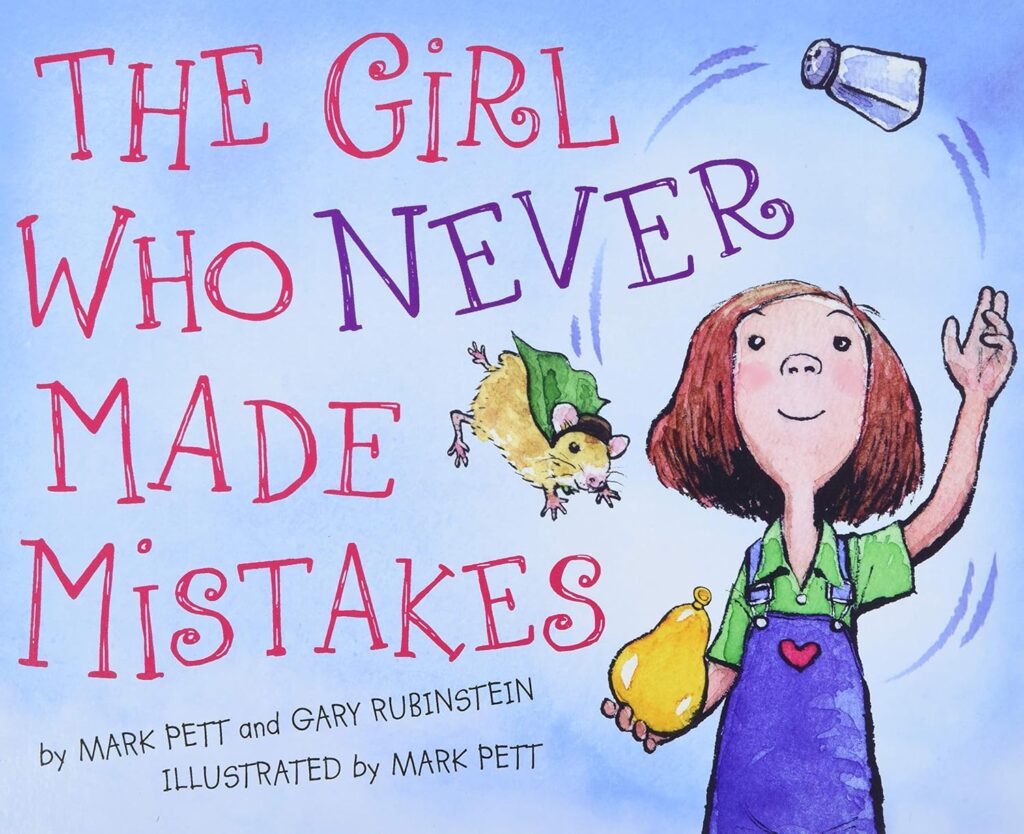
Written by Mark Pett and Gary Rubinstein
Illustrated by Mark Pett
Grade Level
Pre-K – 3rd Grade
Time to Read
12-15 minutes
Core Skills
Vocabulary development, comprehension, inferencing, growth mindset
Key Vocabulary
mistake
an error or something done wrong
nervous
feeling worried or anxious about something
perfect
without any errors or flaws
reputation
what people think and say about you
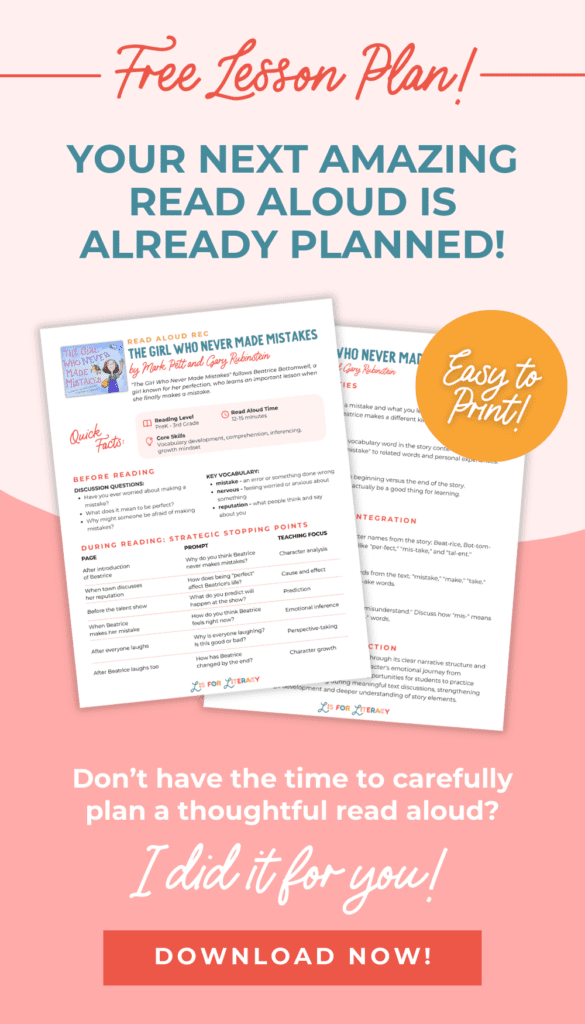
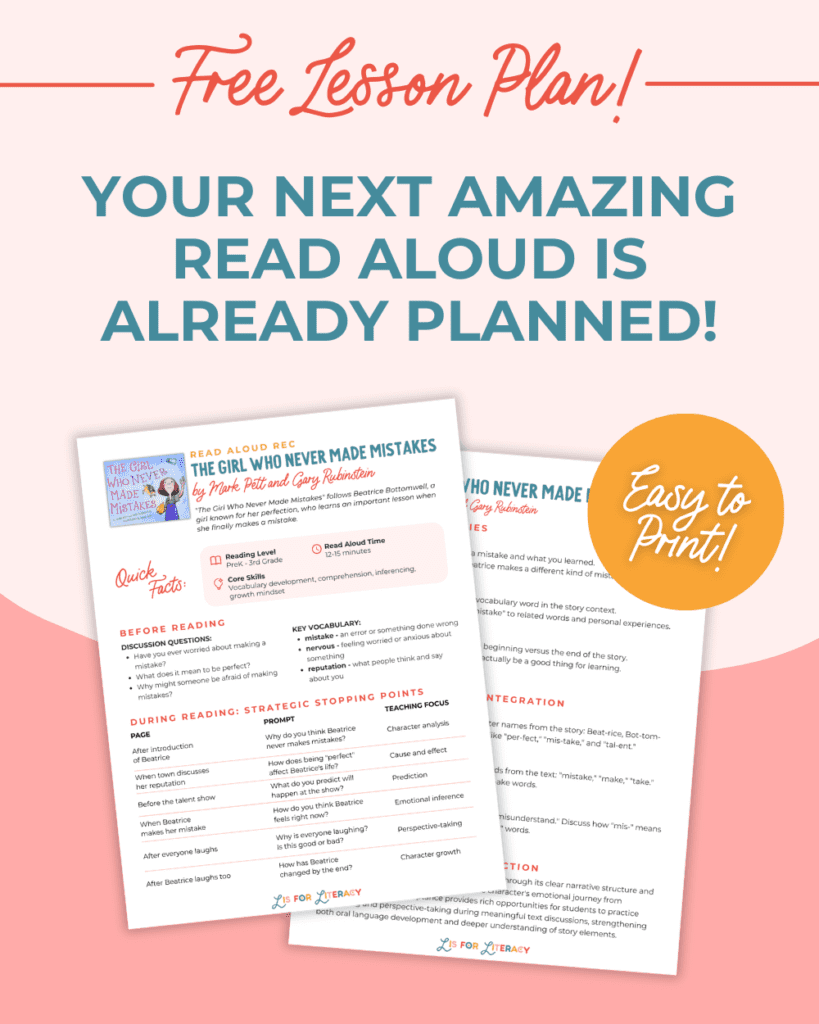
Wish You Could Download This Post As a Beautifully Formatted Lesson Plan?
You Can!!
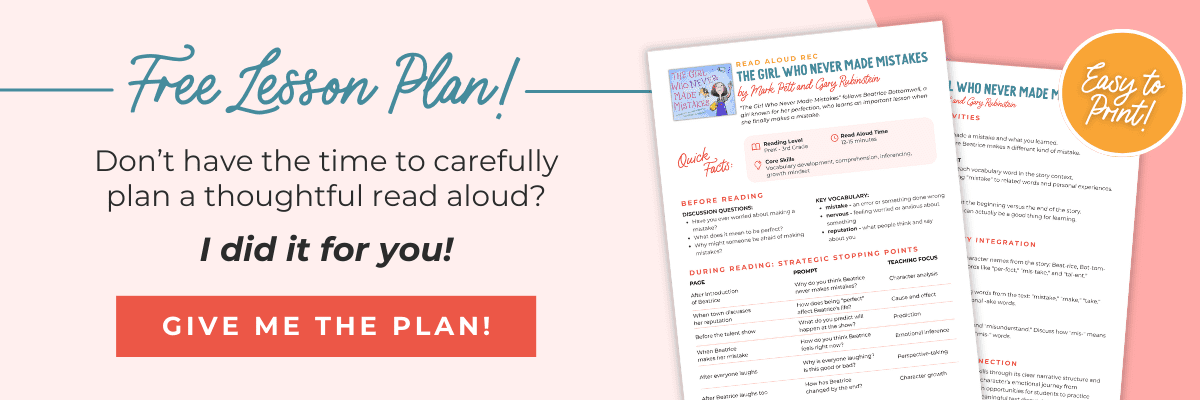
I know that as much as you want to, you don’t always have time to carefully plan a thoughtful read aloud. That’s why I did the hard work for you! Everything you need is in this downloadable Read Aloud Lesson Plan for “The Girl Who Never Made Mistakes?” All of the vocabulary notes, pre-reading questions, strategic stopping points, and ways to extend the learning beyond the story are ready to go, just for you!
Download the free guide and you’ll have everything you need at your fingertips!