L is for Literacy
The Science of Reading Simplified

The Dot Read-Aloud Lesson Plan: Teaching Growth Mindset & Comprehension
You know that moment when a student crumples up their drawing and shoves it in their desk? When they cross out their writing so hard the pencil tears through the paper? When they say “I can’t do this” before they’ve even tried? Every K-2 classroom has at least one child who’s already convinced themselves they’re not an artist, not a writer, not creative—and watching them shut down breaks your heart a little.
The Dot by Peter H. Reynolds speaks directly to that child. Vashti sits glued to her chair, staring at blank paper, insisting she can’t draw. Her teacher’s response—gentle, wise, and completely unexpected—changes everything. But here’s what makes this more than just a sweet story about trying: The Dot builds vocabulary, develops inferencing skills, and creates background knowledge about growth and creativity that supports reading comprehension development. While your students are learning to decode through systematic phonics instruction, read-alouds like The Dot build the language comprehension they need to become skilled readers.
Why The Dot Works for Structured Literacy
Teachers shifting toward more systematic phonics instruction often ask: “If I’m spending 20 minutes daily on explicit phonics, where do rich texts fit? Aren’t read-alouds just a nice break?” Here’s the truth: Strategic read-alouds are essential literacy instruction because they build language comprehension while students develop decoding skills.
Vocabulary in Meaningful Contexts: The Dot introduces three powerful Tier 2 words—”glued,” “swirl,” and “inspired.” These aren’t just nice vocabulary words; they’re academic terms students need across subjects and texts. What makes Reynolds’ approach particularly effective is how the story provides natural context clues. When Vashti sits “glued to her chair,” the illustration shows her stuck there stubbornly while other students leave. Later, “swirl” appears with its visual representation right on the page as Vashti experiments with different artistic techniques. The word “inspired” describes what happens when Vashti encounters the young boy who needs encouragement—students can infer this feeling from the context even before they know the precise definition.
Inferencing That Builds Comprehension Skills: The Dot requires constant inferencing, making it perfect for teaching students to read between the lines. When Vashti’s teacher looks at her angry dot and “just smiled,” students must infer what that smile communicates: belief, acceptance, possibility. The text never states these ideas explicitly. Later, when the teacher frames Vashti’s dot and hangs it above her desk, students infer the profound message: your work matters, you are capable, I see potential in you. These inferencing opportunities with picture support prepare students for the more sophisticated comprehension work they’ll need as texts become more complex.
Background Knowledge About Creativity and Growth: Beyond vocabulary and comprehension strategies, The Dot builds schema about an essential concept: that ability develops through effort and experimentation. This isn’t just a social-emotional lesson—it’s background knowledge that helps students understand countless other texts about learning, perseverance, and creative risk-taking. When you read The Dot in September and reference it throughout the year, you’re creating shared knowledge that deepens comprehension of future texts.
Reading The Dot within a structured literacy framework shows students that systematic instruction and engaging literature work beautifully together to build skilled reading.
Before Reading
Discussion Questions:
- Have you ever said “I can’t do that” about something before you even tried it? What was it, and why did you think you couldn’t do it?
- What does it feel like when a teacher or grown-up believes you can do something that you’re not sure you can do yourself?
- When you create something you don’t like—a drawing, a story, or a project—what do you usually do with it?
Key Vocabulary:
- creative – able to make or think of new things
- blank – empty with nothing on it
- swirl – a twisting, curving pattern or movement
- definitely – absolutely certain or without any doubt
During Reading – Strategic Stopping Points
| PAGE/MOMENT | PROMPT | TEACHING FOCUS |
|---|---|---|
| After “Her paper was empty” | What is Vashti feeling right now? How can you tell from the picture and the words? | Inferring character emotions using text and illustration clues |
| After the teacher says “Ah! A polar bear in a snow storm” | Why do you think her teacher said that instead of telling Vashti she needed to draw something? | Understanding character motivation and supportive responses |
| After “Vashti’s teacher… just smiled” | What is the teacher telling Vashti without using words? Why do you think she smiled instead of talking? | Interpreting nonverbal communication and inferring deeper meaning |
| After Vashti makes “an even better dot” | What changed inside Vashti? Why did she suddenly want to keep making more dots? | Analyzing character transformation and identifying turning points |
| When the boy says “I can’t even draw a straight line” | Why did Peter Reynolds end The Dot this way? What do you predict Vashti will do next? | Understanding circular story structure and predicting based on character growth |
Making This Lesson Work in Your Real Classroom
Timing & Scheduling Tips:
Plan for 10-12 minutes for the first read-through, with 12-15 minutes for discussion using the stopping points. The Dot works perfectly during the first weeks of school when you’re establishing classroom culture, as an anchor text for growth mindset units, or paired with writing workshop lessons about revision and risk-taking.
Classroom Management Strategies:
Structured Turn-and-Talk Protocol: The Dot sparks genuine emotional responses and personal connections that can derail into scattered sharing. After each stopping point, provide a specific sentence frame: “Turn to your partner and complete this sentence: ‘I think Vashti feels ___ because ___’” or “Tell your partner: ‘The teacher smiled because _____.’” Give students exactly 45 seconds of partner talk time (set a visible timer), then call on 2-3 pairs to share their thinking with the whole class. This structure ensures every student engages with the question (not just enthusiastic hand-raisers), provides language scaffolding for students who need it, and keeps the discussion focused and purposeful.
Differentiation That Actually Works:
For Emerging Readers & English Language Learners: Pre-teach the three vocabulary words using simple, memorable gestures—pretend you’re stuck like glue to your chair and can’t move, draw a swirl in the air with your finger, put your hand to your forehead like you just got a brilliant idea for “inspired.” During the read-aloud, use these gestures when you encounter each word to reinforce meaning visually.
For Advanced Readers & Thinkers: Push deeper into author’s craft with questions like: “Why did Peter Reynolds choose to show Vashti’s first dot as an angry jab instead of drawing it carefully? What message does that send?” Challenge these students to compare The Dot to other growth mindset stories and identify what makes Reynolds’ approach particularly powerful.
Extension Activities
Writing Connection:
Have students write a letter from Vashti to her teacher, explaining how the teacher’s response changed everything for her. Kindergartners and early first graders can draw their favorite moment from The Dot and dictate a sentence: “Dear Teacher, when you ___, I felt ___.” Second graders should write a full paragraph identifying the specific moment that mattered most to Vashti and explaining why it created such a big change.
Vocabulary Development:
Create an interactive “glued, swirl, inspired” word wall where students hunt for real examples all week. They might notice someone sitting “glued” to their seat during an exciting story, observe swirls in a cinnamon roll or on a shell, or document moments when they felt inspired to try something new. Photograph these discoveries and add them to your word wall with the vocabulary word, building multiple meaningful exposures in authentic contexts.
Comprehension Builder:
Use a three-column chart labeled “At the Beginning,” “In the Middle,” and “At the End” to track Vashti’s emotional journey. Students draw or write how Vashti felt and what she believed about herself at each story stage. This graphic organizer helps students understand character transformation across a narrative arc—a structure they’ll encounter in countless stories throughout elementary school.
How This Connects to the Bigger Picture of Reading Instruction
When you’re implementing more systematic phonics instruction, you might wonder if you’re spending too much time on decoding and not enough on meaning-making. Here’s what reading science tells us: skilled reading requires both strong decoding AND strong language comprehension working together.
Oral Language Foundations: Your K-2 students’ listening comprehension is typically years ahead of what they can read independently—which is exactly why read-alouds like The Dot are essential right now. You’re building the sophisticated comprehension skills, vocabulary knowledge, and background knowledge they’ll need once their decoding catches up. When you teach students to infer character motivation in The Dot, analyze transformation, and discuss abstract concepts like creative courage, you’re developing thinking skills their current reading level can’t yet support independently—but their brains are absolutely ready for through listening.
Systematic Doesn’t Mean Scripted: Teaching The Dot demonstrates how explicit instruction can be joyful and engaging. Your discussion questions follow a systematic progression from identifying emotions to analyzing character motivation to understanding theme. Your vocabulary instruction is intentional—you’ve pre-selected Tier 2 words and planned multiple exposures. Your stopping points are strategic—designed to build specific comprehension strategies. Students experience this as a wonderful story, but you’re delivering structured, purposeful literacy instruction.
The difference between casual story time and strategic literacy instruction is intentionality. You’ve chosen The Dot deliberately because it builds specific vocabulary, develops essential comprehension skills, and creates background knowledge students will reference throughout the year.
Structured Literacy Integration
Phonological Awareness Practice: Use Vashti’s name for syllable work—clap out “Vash-ti” (2 syllables) and compare it to single-syllable words from the story like “dot,” “smiled,” and “line.” Challenge students to sort story words by syllables: one clap (dot, smiled, line, art) versus two claps (Vash-ti, tea-cher, pa-per). This connects phonological awareness practice to meaningful vocabulary from the book instead of using random word lists.
Word Family Exploration: The Dot contains perfect examples of the -ot word family: dot, got, and (if students notice) spot. After reading, build the -ot family together using magnetic letters: “We read about Vashti’s dot. What other words rhyme with dot?” Create hot, pot, not, lot, and cot. Then send students on a word hunt through the book to find any -ot family words they can spot.
The Science of Reading Connection
The Dot exemplifies how strategic read-aloud instruction builds the language comprehension strand of Scarborough’s Reading Rope. This lesson develops academic vocabulary (glued, swirl, inspired), teaches inferencing through analyzing character motivation and nonverbal communication, and creates background knowledge about growth and creativity that supports future learning. When you approach The Dot with intentionality—planned stopping points, explicit vocabulary instruction, and structured discussion protocols—you’re demonstrating that engaging literature and systematic instruction enhance each other beautifully.
Why The Dot Belongs in Every K-2 Classroom
Here’s what makes The Dot more than just a pretty book about art class: it fundamentally shifts how students see themselves as learners and creators. Reynolds’ spare text and expressive illustrations work together to show that creativity isn’t about talent—it’s about willingness to try. The story’s genius is in what it doesn’t say explicitly: the teacher never lectures Vashti about effort or growth. She just smiles, frames the dot, and lets Vashti discover her own capability.
Every year, I watch this book transform at least one child who believes they “can’t” into someone willing to experiment. It becomes our classroom shorthand for courage—when someone says “I can’t write this story,” another student will say “Remember Vashti’s dot?” The book plants seeds that grow throughout the year, creating a culture where mistakes become experiments and “I can’t” becomes “I haven’t figured it out yet.” What will happen in your classroom when students realize their angry jab on a page might be exactly where creativity begins?

Written and Illustrated by Peter H. Reynolds
Grade Level
K-3rd Grade
Time to Read
10-15 minutes
Core Skills
Growth mindset, self-expression, comprehension, inferencing
Key Vocabulary
creative
able to make or think of new things
swirl
a twisting, curving pattern or movement
definitely
absolutely certain or without any doubt
definitely
absolutely certain or without any doubt

Wish You Could Download This Post As a Beautifully Formatted Lesson Plan?
You Can!!
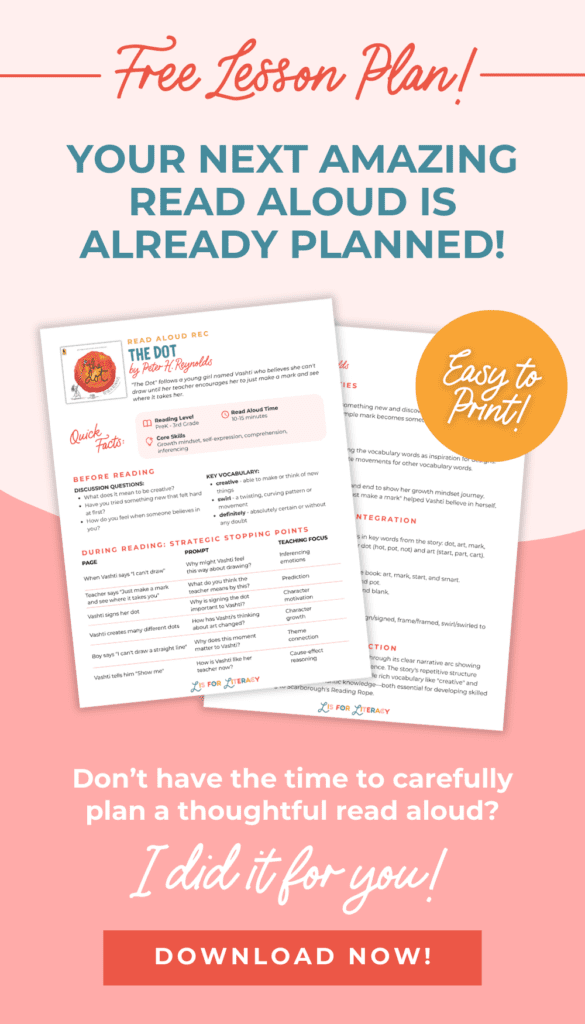
I know that as much as you want to, you don’t always have time to carefully plan a thoughtful read aloud. That’s why I did the hard work for you! Everything you need is in this downloadable Read Aloud Lesson Plan for “The Dot?” All of the vocabulary notes, pre-reading questions, strategic stopping points, and ways to extend the learning beyond the story are ready to go, just for you!
Download the free guide and you’ll have everything you need at your fingertips!